










*Nothing Definitive Yet, But Health Officials Now Investigating Whether She May Have Crossed Paths With Kenyan Man Who Died From Ebola And Had Travelled Through Uganda’s Main Airport Same Day
*WHO Contradicts Nigeria On Woman’s Health Condition, Says ‘She’s Improving’
Fresh information has emerged on the woman diagnosed with the dreaded Ebola in Abuja as Switzerland’s Foreign Ministry has confirmed that she is the wife of a Swiss diplomat.
The development came as bickering broke out among Nigeria, World Health Organization (WHO), Africa Centre for Disease Control (CDC), on one hand, and Uganda, the 42-year-old woman’s country, on the other, over where exactly she contracted the disease, which has killed over 4,600 people in Democratic Republic of Congo (DRC), a country contiguous to Uganda.
The woman, who lives in Abuja, tested positive for the virus on 20 October, becoming Nigeria’s first confirmed Ebola patient in more than a decade.
The Swiss Ministry said she and her husband had both travelled to Uganda earlier this month, with the man currently in isolation but has not developed any symptoms.
Ebola is a serious viral disease that spreads through direct contact with the blood or other bodily fluids of an infected person, or with contaminated objects. It does not spread through the air.
The virus can cause fever, severe weakness, vomiting and diarrhoea, and can be fatal. People are not considered infectious before they develop symptoms.
The Swiss Ministry told the BBC that all 25 staff at its embassy in Nigeria were in good health and did not need to isolate.
The Ministry said the woman had spent about a week at a private clinic in Abuja with symptoms before her diagnosis.
It believed she contracted the virus while travelling in Uganda, although health authorities have yet to establish the source of her infection.
Uganda borders DRC. Two people died in Uganda shortly after the outbreak began in May but it has been declared free of Ebola since August.
The WHO said it was too early to determine where the Abuja victim became infected.
“The source of exposure is still not known. The travel history of the patient is still being pieced together,” said WHO emergency response official, Dr Patrick Otim.
He said investigators had struggled to obtain a complete account of her movements because opportunities to interview her were limited while she remained in hospital.
Nigeria’s Centre for Disease Control and Prevention (NCDC) said it was carrying out genomic sequencing, which could help establish whether her infection is linked to other cases.
However, it has since confirmed that she has the Bundibugyo species of Ebola, the same one which has caused the outbreak in DRC.
“The investigation is reconstructing the full travel and exposure history. Genomic sequencing is given a high priority,” WHO’s Representative in Nigeria, Dr Pavel Ursu, said.
Row Over Her Travel Route
But, Ugandan health officials previously said the woman had travelled to eastern DRC for business.
However, the WHO, Africa Centre for Disease Control (CDC) and Nigeria’s Ministry of Health and Social Welfare said they had not received verified information confirming that she had visited the country.
Uganda has maintained that it has no confirmed active Ebola cases, insisting that the woman’s travel through the country does not necessarily mean she contracted the virus there.
The Swiss government poured cold water on this position, telling Reuters today (Friday) that the patient did not travel to DRC, thus contradicting accounts from Uganda.
She developed symptoms four days after arriving in Abuja and sought treatment at two private health facilities before testing positive for Ebola on 20 October, it added.
The Swiss Ministry said the decision not to isolate the embassy’s eight Swiss and 17 local employees was taken in consultation with Nigeria’s Health Ministry and WHO.
It added that the embassy remained open and operational, with health and safety measures in place.
Health officials are now investigating whether she may have crossed paths with a Kenyan man who died from Ebola and had travelled through Uganda’s main airport on the same day.
The Kenyan man had travelled from DRC through Uganda before arriving in Nairobi on 3 October. He died shortly afterwards, becoming Kenya’s first recorded Ebola death.
Concerns Over Porous International Borders
The developments have renewed concerns about the movement of infected people across international borders, particularly between DRC and Uganda, where thousands cross daily for trade, work and family visits.
Dr Otim warned that the long and porous border between the two countries made it difficult to screen everyone entering or leaving, as many people used unofficial crossing points.
She’s Improving, Says WHO
The woman is receiving treatment in isolation and is showing signs of imrovement, according to the WHO.
This position sharply contradicts the version given to the public on Wednesday by NCDC which said she had suffered multi-organ failure with her health deteriorating.
On that day, speaking during an emergency meeting, NCDC Director of Public Health Laboratory Service, Olajumoke Babatunde, said the patient had suffered multi-organ failure.
Babatunde reportedly added: “The patient’s condition has deteriorated. We did three levels of tests, but all were molecular. The strain was Bundibugyo.”
She returned to Nigeria on 3 October after spending about two-and-a-half weeks in Uganda.
Investigators are examining whether the couple could have been exposed through shared equipment or other contact, the Africa Centres for Disease Control and Prevention (Africa CDC) said on Thursday.
Africa CDC’s Head of Emergency Preparedness and Response, Dr Wessam Mankoula, said this was “one of the possible scenarios”, but stressed that no link had been established.
Meanwhile, Nigerian authorities are tracing more people who may have been exposed to the woman, beyond the 44 contacts initially identified.
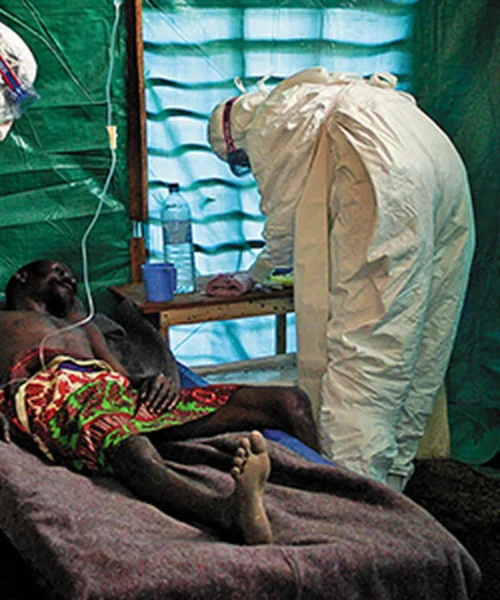
*PHOTO CAPTION: An Ebola victim.