










*Her Life In Jeopardy
*No Available Cure For Her Strain Of Ebola -WHO
*Patient Identified As A Diplomat
*Ebola Absent In Oyo, We’ve Taken Precautions -State Govt
By our reporter, Abuja, and Stephen Gbadamosi, Ibadan
The health condition of the woman diagnosed with Ebola in the Federal Capital Territory (FCT) has worsened considerably with some of her vital organs no longer working.
The update came today (Wednesday) from the Nigeria Centre for Disease Control and Prevention (NCDC) in Abuja.
The disclosure came as Oyo State government allayed fears of presence of the disease in the Pacesetters State, saying Ebola is absent in the heavily populated South-West State.
Speaking during an emergency meeting, Director of Public Health Laboratory Service at NCDC, Olajumoke Babatunde, identified the patient as a diplomat, saying she has multi-organ failure.
Babatunde added that three levels of molecular tests showed her strain of Ebola to be the Bundibugyo type.
According to the World Health Organisation (WHO), that particular type or strain of Ebola, which has killed several thousands of people in Democratic Republic of Congo (DRC), has no approved vaccine or specific treatment at the moment.
Checks by People&Politics showed that, medically known as Multiple Organ Dysfunction Syndrome (MODS), multi-organ failure is life-threatening and indicates that two or more vital organ systems have stopped working properly and so fail to maintain normal body functions without intensive medical intervention.
Recall that on Tuesday, Coordinating Minister of Health and Social Welfare, Prof Ali Pate, had lifted the lid on the presence of the dreaded Ebola in Nigeria, saying a patient, who is presently admitted in a health facility in Abuja and isolated, flew in on an international flight from Uganda, had fallen sick with malaria-like symptoms for several days in hospital, with laboratory tests eventually confirming that the symptoms were those of Ebola.
The Minister added that subsequently, contact tracing had kicked off with 44 close contacts, including healthcare workers, patients, caregivers and travel contacts, all reached.
It is noteworthy that WHO and local media reports in the DRC, where Ebola is currently a major national affliction, say as of 19 October, 2026, the outbreak has claimed 4,602 lives.
Speaking today, Babatunde added: “The patient’s condition has deteriorated. We did three levels of tests, but all were molecular. The strain was Bundibugyo.”
Incident Manager of the National Ebola Response, Dr Odianosen Ehiakhamen,said the patient developed symptoms on 7 October, 2026, and presented at the hospital on 11 October.
Ebola Absent In Oyo, We’ve Taken Precautions -State Govt
In Oyo, the State government has assured residents that no confirmed case of Ebola Virus Disease (EVD) has been recorded in the state, stressing that proactive measures have been put in place to prevent and contain any potential outbreak.
State Commissioner for Health, Dr. Oluwaserimi Ajetunmobi, urged residents to remain calm, vigilant and adhere to recommended health and safety precautions.
According to a statement by the State Commissioner for Information, Dotun Oyelade, the Health Commissioner disclosed this today during an interview with journalists in her office.
She explained that the Ministry had commenced preparations, as far back as June 2026, to strengthen the state’s readiness for potential outbreaks of Ebola and other infectious diseases, including diphtheria.
Dr. Ajetunmobi stated that under the ‘One Health’ approach, the Ministry had initiated collaboration with relevant stakeholders, including Ministries of Information, Agriculture and Environment, as well as the Epidemiology Unit of the University College Hospital (UCH), Ibadan, to strengthen surveillance, preparedness and response mechanisms across the 33 Local Government Areas (LGAs) of the state.
Highlighting the Ministry’s
preparedness efforts, the Commissioner noted that disease surveillance units had been activated across the LGAs, while Information, Education and Communication (IEC) materials containing information on Ebola transmission, prevention measures and emergency contact numbers had been printed and distributed to health facilities across the state.
She added that infection prevention and control measures had also been reinforced across healthcare facilities, with healthcare workers advised to maintain a high index of suspicion for patients presenting with symptoms suggestive of Ebola and to adhere strictly to appropriate infection prevention and control protocols, including the use of personal protective equipment (PPE).
According to the Commissioner, the early symptoms of Ebola might resemble those of malaria, but residents should seek prompt medical attention, if they experienced symptoms such as sudden fever, severe headache, joint or muscle pain, vomiting, diarrhoea, extreme tiredness, abdominal pain or unexplained bleeding from body openings, including the nose, ears, eyes or vagina.
She explained that the incubation period for EVD ranged from two to 21 days.
On case management, Dr. Ajetunmobi assured residents that trained healthcare personnel, including laboratory teams responsible for sample collection and testing, were available to respond to any suspected case.
She also explained that the Infectious Disease Centre (IDC) at Olodo was fully prepared, as part of the state’s response arrangements, noting that the Ministry’s preparedness efforts had commenced in June.
She emphasised that the Ministry was intensifying risk communication and public awareness, stressing that a coordinated response involving government agencies, healthcare workers, the media and communities was essential for early detection, prompt reporting and effective containment of the disease.
She reiterated that there was currently “no confirmed case of Ebola Virus Disease in Oyo State,” urging residents to remain calm, avoid spreading unverified information and cooperate with public health authorities.
Dr. Ajetunmobi further advised residents to practise regular hand-washing with soap and water or use alcohol-based hand sanitisers, where appropriate.
She cautioned against direct contact with the blood and other body fluids of suspected or confirmed cases, as well as contaminated materials, and encouraged anyone experiencing the symptoms mentioned to contact a health facility or the appropriate public health authority promptly.
The Commissioner called on residents to remain vigilant without panic, emphasising that public cooperation and adherence to official health advisories were crucial to safeguarding the health of everyone in the state.
“Residents who require assistance or wish to report a suspected case are advised to contact the appropriate zonal emergency numbers:
Ibadan Zone (0803374205, 08025245809, 08033515158, 07039531882); Ogbomoso Zone (08195531882, 08024347856); Oyo Zone (08132407856, 08033397856); Ibarapa Zone (08020325728, 08020335728); and Oke-Ogun Zone (09062433608, 07067737410),” she said.
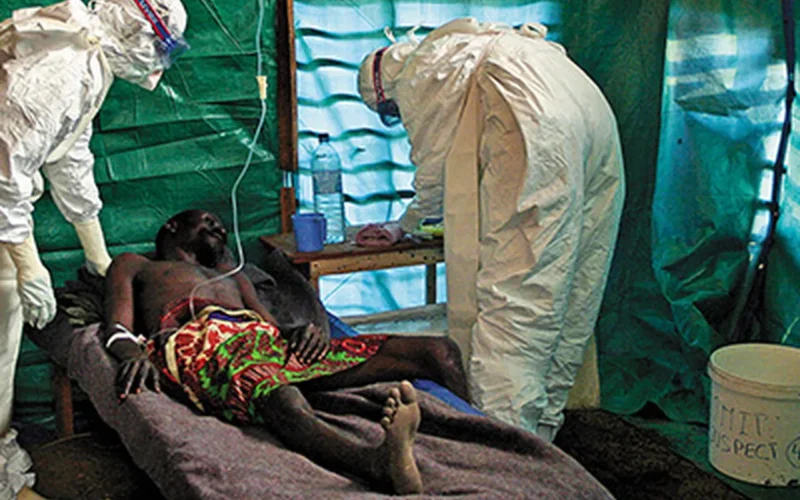
*PHOTO CAPTION: An Ebola patient.