


By Felix Durumbah, with Reuters and other reports
Through deliberate and concerted national effort, Morocco has, in recent time, established itself as a leading fortress of football in Africa and, leveraging this, seeks to stamp same reputation in global football.
The marketing and investment spinoffs from this are unquantifiable. But that is a separate topic.
As we write, the Maghrebian nation is already safely ensconced in the quarter-finals of the ongoing FIFA World Cup being co-hosted by the US, Canada and Mexico. Morocco trounced Canada 3-0 to secure its berth.
A serious-minded, focused nation of about 38.8 million people, Morocco, of course, in 2022 in Qatar printed its name in gold in the marbles of time by becoming the first African country to reach the semi-finals of the FIFA World Cup.
This is noteworthy given that African nations have been competing in the World Cup since 1934 (92 years now!) when Egypt became the first and only African country to qualify for the mundial, held that year in Italy.
In 2026 alone, Morocco has hosted (or is hosting) several marquee football events.
These are: the TotalEnergies CAF Africa Cup of Nations (AFCON) 2025, which kicked off in December 2025 and ended in January 2026; the 2026 U-17 Africa Cup of Nations in May/June; and the expanded 2026 Women’s Africa Cup of Nations (WAFCON) from July 25 to August 16, 2026.
Further testimony to the country’s footballing organization, prowess and development came in the 2026 CAF Champions League, a tournament for the best clubsides on the continent, with Morocco’s AS FAR playing in the final and narrowly losing 2-1 to South Africa’s Mamelodi Sundowns.
Also, Morocco is set for the biggest of it all as it has won the bid to, alongside Spain and Portugal, host FIFA’s 2030 World Cup, gaining the distinction of being the second African country –outside South Africa –to host the biggest football event on the planet.
For this showpiece global event, Morocco is building the biggest stadium in human history: the Grand Stade Hassan II, with a capacity of 115,000 spectators.
Located on a 100-hectare site in Benslimane, roughly 38 km north of Casablanca, the $500 million mega-project is slated for completion by 2028 and is a flagship venue for the 2030 edition.
In some African countries, the cost of this project will be inflated by public officers who see it as a veritable avenue for self enrichment, at the expense of national integrity, accountability, transparency and probity.
Now, to the crucial question: What is the factor fuelling Morocco’s bloom in continental and global football?
Morocco’s rise in global football is being powered by an unlikely source of funding: The country’s vast phosphate reserves, with the state fertilizer giant bankrolling the national team’s development.
OCP Group, the world’s largest phosphate fertilizer producer and exporter, has thrown its weight behind Moroccan football through a National Football Training Fund launched in 2024, joining forces with the Royal Moroccan Football Federation and private funders to elevate the sport to new heights.
Phosphate is a finite resource critical to agriculture that cannot be synthesized using basic ingredients, unlike nitrogen fertilizers, which are generally made from natural gas.
Morocco is blessed with an abundance of this rare and essential fertilizer, upon which the earth’s farmers depend, according to global fertilizer market analyst Josh Linville of analytical and trading firm StoneX.
“We have this commitment to the development of the country,” said President of the OCP-funded University of Mohammed VI Polytechnic and part of OCP’s strategic Committee for Innovation and Learning, Hicham El Habti, explaining why a fertilizer producer would invest in football under a “royal directive” for state-owned institutions.
“There’s a huge investment from OCP in the training fields. There is a partnership with FIFA,” said El Habti as Morocco prepared for their World Cup round-of-16 clash against Canada in Houston on Saturday, 4 July.
OCP’s recent contributions are not the start of the efforts Morocco has made to become more of a power in African and world football.
In 2009, King Mohammed VI directed the nation’s government to invest in the country’s football infrastructure, including pitches, training academies for youth, stadiums and professional coaches.
OCP joined the project in 2024 to take Moroccan football to another level.
It funds training academies, “equipping them with modern infrastructure, efficient facility management and advanced technical expertise,” said OCP when the fund was launched.
Footballing Prowess
Morocco’s increasing footballing prowess is now broadly acknowledged, with the team reaching the semi-finals of the 2022 World Cup and being awarded the 2025 Africa Cup of Nations title after a controversial final earlier this year.
“Morocco is the bright spot in an otherwise dismal phosphate marketplace,” said Linville.
China restricts exports, Russia is geopolitically unreliable, US production has a questionable future, and Saudi Arabia is dealing with the newly arisen critical problem of the vulnerability of the Strait of Hormuz passage.
Morocco is also free from most challenges facing its competitors. Recently the US Trump administration lifted some of its restrictions on Moroccan phosphate imports to ease shortages and high prices created by the Iran war.
For El Habti, investing Moroccan state money in football is bringing results he can see whenever he’s around fellow citizens.
The 2022 World Cup, in which Morocco came fourth and knocked out Spain and Portugal, and beat Belgium, raised millions of spirits and today is similar.
“You will see every face smiling,” he said. “It reminds us of 2022… Morocco was a very happy country for two months after the end of (the World Cup). I’m feeling exactly the same energy, the same vibes now.”
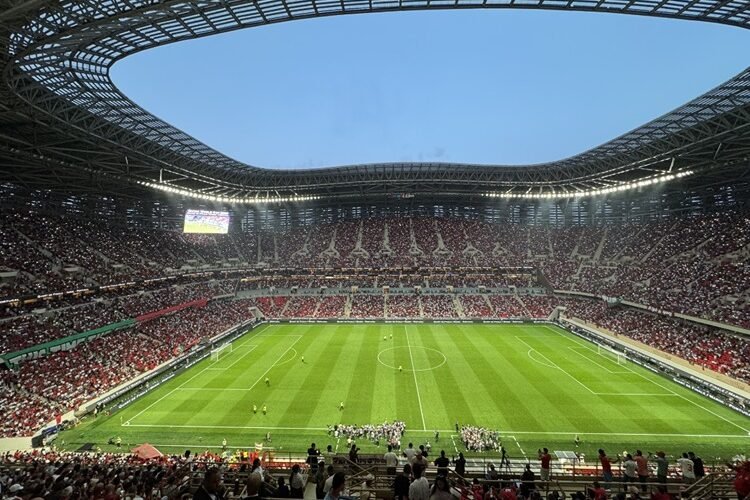
*PHOTO CAPTION: The Stade Moulay Abdellah in Rabat, Morocco.