










By Tony Ezimakor, Abuja
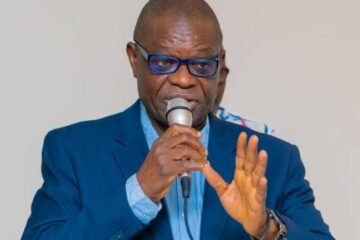
President of GLOBE Legislators, Hon. Sam Onuigbo, has challenged African leaders on the urgency to move beyond climate change rhetorics, pledges and negotiations to birth laws, institutions, financing mechanisms and implementation pathways that would shape the continent’s climate future.
GLOBE Legislators is a non-partisan, cross-party parliamentary organisation dedicated to improving governance for sustainable development.
Founded in 1991 by Senators Al Gore, John Kerry and their counterparts in the European Parliament, Russian Duma and Japanese Diet, GLOBE has grown to include legislators from every global region.
Hon. Onuigbo, spoke on Monday at the 14th Conference on Climate Change and Development in Africa, CCDA-XIV, held at the United Nations Conference Center, in Addis Ababa, Ethiopia, insisting that Africa cannot depend solely on external promises to address a looming climate crisis already threatening its development.
He said the continent, with its vast critical minerals, maritime resources, and youthful population, must now exercise greater climate agency by setting the tone and shaping the rules, birth institutions, and create finance and implementation pathways to address the harsh reality of climate change rather than remain a beggarly recipient of decisions made elsewhere.
Echoing the historic declaration 50 years ago by the late Nigerian leader, General Murtala Muhammed that “the fortunes of Africa are in our hands to make or mar”, Onuigbo said that charge, made at the Extraordinary Summit of the Organisation of African Unity (OAU) in Addis Ababa in January 1976, is even more relevant today.
The conference, which runs from 7-9 September, has the theme: ‘From Pledges to Implementation: The Belém-Antalya-Addis Roadmap’.
Onuigbo, who sponsored the ambitious Nigeria’s Climate Change Act 2021, said the conference theme captured one of the most pressing challenges confronting Africa and the global climate regime , namely translating international commitments into laws, institutions, financing and practical solutions capable of delivering results.
Onuigbo stressed that Africa’s climate challenge has moved beyond vulnerability and was now fundamentally a question of agency.
According to him, while the continent had continued to make a strong case for climate justice, pointing to its relatively low contribution to greenhouse-gas emissions and disproportionate exposure to climate impacts, it must now complement that position with the capacity to decide, design, build, finance, govern and defend its own climate solutions.
“Climate priorities describe what Africa needs. Climate agency defines what Africa decides, designs, builds, finances, governs, and defends for itself,” he said.
Onuigbo explained that being present at international climate negotiations was not enough, just as having African interests reflected in declarations and negotiating texts did not amount to genuine leadership.
“Participation means Africa is present at the table. Representation means Africa’s interests are counted in declarations, boards, communiqués, and negotiating texts.
“Agency is different. Agency means Africa sets terms rather than merely responding to terms set elsewhere. It means designing instruments rather than qualifying for instruments designed by others. It means deciding who assesses, who approves, who disburses, and who benefits.
“A continent can be well represented in a system it does not shape. Climate leadership means moving from being consulted to being the author,” he said.
Onuigbo cautioned leaders not to treat implementation as a mere technical follow-up to international negotiations but as a development strategy aimed to drive resilience, energy access, industrialisation, job creation, technology, food security and sustainable development.
While he maintained that African countries will continue to demand equitable international climate finance, he warned against total dependence on external pledges whose deliverables are often uncertain, delayed or controlled by non-African intermediaries.
According to him, Africa’s Nationally Determined Contributions (NDCs) should no longer be viewed merely as diplomatic submissions, but implementation architectures containing investment frameworks, sectoral plans, accountability mechanisms and pipelines of bankable projects.
Every climate commitment, he advocated, should address practical questions about deliverables, who delivers it, cost, source of finance, method of measurement and how the gains would be protected through political transitions.
“This requires laws, budgets, institutions, oversight, technical capacity, and project-preparation systems,” he stated.
Citing example with the Nigeria Climate Change Act 2021 to buttress the role of climate agency, Onuigbo said the legislation demonstrated how climate ambition could be translated into law and governance.
He said the Act established a statutory framework for climate action and created institutional responsibility through the National Council on Climate Change (NCCC) while placing climate coordination at the highest level of government.
Drawing from his experience in public administration, Onuigbo introduced the term “peer jealousy” to describe the unhealthy rivalry that can arise among Ministries and Agencies of equal standing, saying its elimination informed the decision to make the appointor the head of the focal climate outfit.
According to him, placing the Council under the Presidency and making the President its chairman addressed a major governance challenge in climate action – the rivalry among Ministries and Agencies competing for authority, visibility and resources instead of working towards coordinated delivery.
Onuigbo said climate governance required a coordinated approach because climate action cuts across virtually every sector of the economy, including environment, finance, energy, petroleum, transport, agriculture, trade, industry, solid minerals, water, planning and science.
“Without a clear coordinating authority, implementation can be weakened by overlapping mandates and institutional competition. Nigeria’s Act shows that climate governance requires not only targets but authority, coordination, accountability, and continuity,” he said.
He also stressed the need for climate policies and investments to survive changes in government, noting that adaptation, infrastructure, energy transition and industrial transformation required long-term investment horizons.
Onuigbo said Nigeria’s experience with the floods of 2012, 2022 and 2024 further demonstrated the cost of inadequate climate preparedness, with lives, livelihoods, crops, infrastructure and economic activities affected.
He called for a shift from reactive disaster management to anticipatory climate-risk management through flood-risk mapping, drainage systems, dam safety, wetlands protection, land-use planning, early-warning systems, resilient infrastructure and climate-responsive budgeting.
The GLOBE Legislators experience, he added, offered another pathway for strengthening African climate agency, particularly through parliamentary action.
According to him, legislators were central to climate implementation because climate commitments become tangible through laws, budgets, oversight and accountability.
Onuigbo urged African legislators to strengthen cooperation through GLOBE Legislators by sharing legislative models, improving oversight, supporting climate-responsive budgeting and aligning national laws with continental and global climate objectives.
“Success will not be measured only by declarations adopted, but by whether a farmer is better protected from drought and flooding, a community has reliable energy, a young African can build a green enterprise, women have access to finance and land, cities are resilient, industries can compete, and Africa’s natural resources create African value,” he said.
Onuigbo concluded that Africa’s vulnerability to climate change should not obscure the continent’s enormous capacity to provide global climate solutions.