










Iran’s Supreme National Security Council on Saturday declared the Strait of Hormuz will not open until the United States (US) “corrects its behavior,” issuing new demands that could shake up talks on a deal to manage the waterway and traffic on it.
Iran’s state broadcaster published the statement by the Council’s Secretary, Mohammad Bagher Zolghadr, who is also a Commander in the powerful Islamic Revolutionary Guard Corps (IRGC).
The US must never threaten Iran again, the statement said, and must permanently end the war with Iran and its armed allies in the region.
The US must lift the naval blockade of Iranian ports and withdraw its military from the area.
It also must “completely compensate” Iran for war damage, lift sanctions and “unconditionally” release frozen assets.
This new list of demands reflected the demands Iran was previously making as a condition for a permanent accord with the US.
That envisaged accord was intended by the US as also resolving the threat posed by Iran’s nuclear program and its stockpile of 60%-enriched uranium.
Instead, the demands were being issued as conditions for an accord under which Iran would consent to reopen the Strait of Hormuz.
Washington correspondent of Israel’s Channel 12 news, Barak Ravid, told the network that “clearly the US cannot accept” those demands and that they could potentially push US President Donald Trump back toward the military option that he shelved only days ago.
There was no immediate comment from the US, which has wanted an acceptable deal first on the strait before ending the blockade.
According to the interim deal signed in June, a schedule to end sanctions and plan for compensation would be part of the final deal, and negotiations would address frozen assets.
The 60-day period to negotiate a final deal will end in just over a week but could be extended.
Iran has said it was close to reaching a separate deal with Oman to manage the strait, which runs between the two countries.
Iranian Foreign Minister Abbas Araghchi earlier Saturday said they were close to reaching an agreement on navigation, “specifically the determination of a transit route.”
But the waterway’s reopening was contingent on other conditions, he said in remarks shared on social media, and blamed the situation on what he called the US violation of the interim deal.
The IRGC also said earlier Saturday that reopening Hormuz was unrelated to the negotiations with Oman and would depend on Washington accepting Tehran’s conditions.
“The enemy is forced to accept Iran’s conditions for the opening of the strait and to refrain from the interference that it is currently making in the negotiations — which have almost reached their end — between Iran, Oman and other countries,” the IRGC said.
‘No Plans To Toll Hormuz’
As the Islamic Republic issued its new demands, US Vice President JD Vance said to Fox News that Tehran told Washington it had “no plans” to impose tolls on the Strait of Hormuz.
“Some people within the Iranian system” have talked about tolling the waterway, he said, adding that “the Iranians have told us they have no plans to toll the Strait of Hormuz.”
“But again, we’re going to see what actions actually happen,” Vance said.
According to Vance, the expectation of the Trump administration was that “we see the same amount of oil and gas come out of the Gulf that you saw before the conflict.”
“The one problem of course is that the Iranians laid a large number of mines at the beginning of the war and so what we’re really working through is how you can actually set up a traffic scheme so ships that pass can pass through safely,” Vance continued.
“That of course includes de-mining, it also includes a commitment from the Iranians that they are not going to fire at commercial vessels,” he added.
A diplomat from one of the mediating countries said that Vance was correct in stating that the temporary deal to reopen the Strait of Hormuz will bar either side from charging tolls.
Iran, however, has not ruled out the imposition of tolls once that deal expires, with state-owned news outlet Press TV reporting Friday that a parliamentary committee was reviewing a preliminary bill that would introduce fees for transiting the waterway, while barring US, Israeli and other “hostile” vessels from passing through.
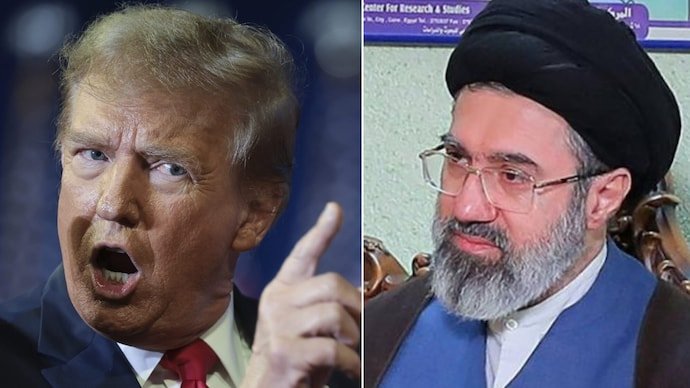
*PHOTO CAPTION: Trump (left) and Iranian Supreme Leader Mojtaba Khamenei.