







By ANAYO AGU
Lagos, September 22, 2026
There are moments when a business transaction becomes larger than business. It becomes a statement about a people’s confidence, a continent’s possibilities and the future its leaders are prepared to build. The question such moments force on us is uncomfortable but long overdue: if Africans will not invest in Africa, on what basis do we ask the rest of the world to do so?
I first glimpsed the implications of this question at the Tony Elumelu Foundation, in its audacious confrontation with the barriers facing Africa’s startups and early-stage founders. They are conspicuous to me, too, in the annual gathering of young Africans hungry for the wisdom, guidance and capital to turn ambition into honest service and significance. The initial public offering of Dangote Petroleum Refinery and Petrochemicals may prove a second and far larger illumination: Africa’s awakening to the crippling cost of excluding ordinary citizens from its own financial markets—an inflection point generations unborn may study as a model and a paradigm shift.
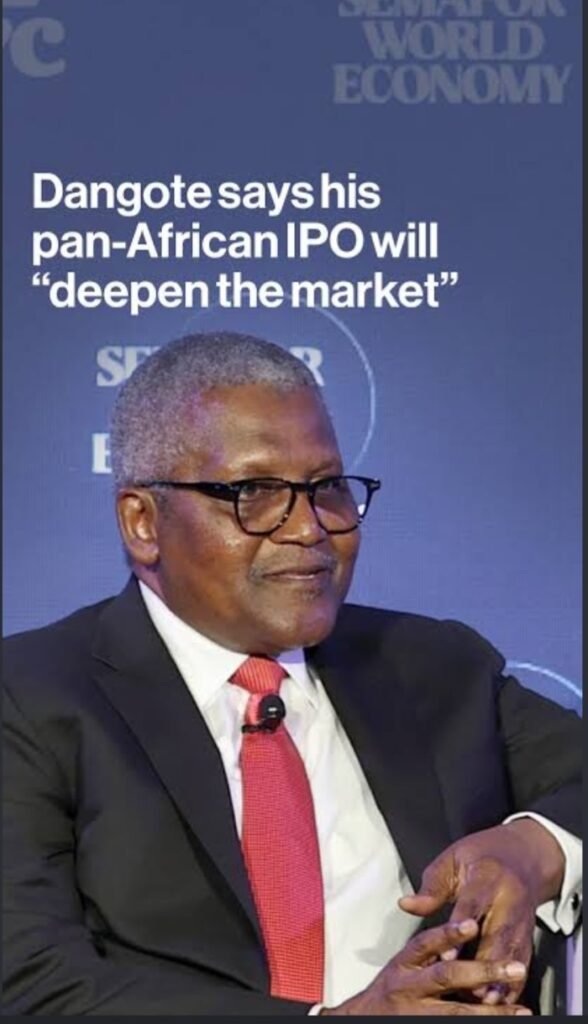
Africa’s largest-ever public share offering matters not merely for its unprecedented size, the strategic weight of the refinery or the global stature of its founder. I believe its deeper significance lies in the philosophy behind it: Africans must lead in investing in Africa, and ordinary people must be given a meaningful stake in the wealth created on their own continent.
Aliko Dangote has argued repeatedly that Africa will not overcome the world’s perception of it as an excessively risky destination by endlessly appealing to foreign investors. Foreign capital will continue to scrutinize Africa’s risks, often more critically than it examines comparable risks elsewhere, and no amount of persuasion changes that. The most persuasive response, therefore, is not another appearance at the World Economic Forum, another presidential visit or another investment roadshow in Europe, America or Asia. It is Africans investing substantially and successfully in Africa. “If I’m not investing in Africa, I cannot convince anyone else outside the continent to invest,” Dangote has observed—an argument born of global experience and the courage of his convictions. African capital must lead before global capital can confidently follow.
For more than two decades, the U.S. Commercial Service at the United States Consulate in Lagos championed a similar principle through hundreds of International Buyer Programs. We led Nigerian delegations to some of the largest trade shows in the United States, helping participants pursue strategic alliances, distributorships and investment partnerships. We encouraged Nigerian business and government leaders to tell the country’s story with evidence—to demonstrate through their own enterprises that Nigeria deserved American capital. One contradiction repeatedly undermined both the effort and the message: some of the leaders asking foreigners to invest in Nigeria appeared more interested in acquiring private property in America than in demonstrating confidence in the opportunities at home. They asked outsiders to take risks they were unwilling to take themselves.
The Dangote example is therefore a breath of fresh air. It embodies patriotism, integrity and entrepreneurial wisdom in equal measure. Credibility begins with walking our talk, with being masters of our own destinies before we can inspire the confidence outsiders require to follow.
De-risking Africa by Doing the Difficult
Dangote’s campaign to de-risk Africa did not begin with this IPO. It began with his willingness to undertake projects many considered impossible in Nigeria.
The refinery was built amid inadequate infrastructure, foreign-exchange volatility, regulatory uncertainty and persistent doubt about Africa’s capacity to execute at global scale. Constructed at a cost exceeding $20 billion, it is evidence that one of the world’s most complex private-sector projects can be conceived, financed, built and operated on African soil. The precedent was equally daunting: Obajana proved an enterprise of global stature could be built in Africa, and Dangote Cement carried that model across several African markets. The refinery takes the proposition to an unprecedented scale.
The conventional response to risk is to avoid difficult environments. Dangote’s approach has been the opposite: enter the difficult environment, mobilize the resources, build the missing infrastructure and develop the capacity that reduces the risk. He is not asking investors to believe in Africa; he has risked his capital, his reputation and decades of enterprise-building to demonstrate what that belief requires in practice.
Africa will not be de-risked by rhetoric, ceremonial state visits, or by borrowing more money from multilateral agencies and wealthy nations. It will be de-risked when successful African enterprises prove that the continent can transform its resources locally, build world-class infrastructure and create value at a scale that attracts both domestic and international capital. Barack Obama captured the responsibility exactly: “We are the ones we’ve been waiting for.” The refinery, then, is not simply processing crude oil. At its most consequential, it is processing perception.
From Concentrated Wealth to Distributed Ownership
The approved offer comprises 4.1 billion ordinary shares at ₦525 per share, with a minimum subscription of ten shares — meaning an individual can participate with ₦5,250. The offering seeks to raise approximately ₦2.15 trillion, about $1.6 billion, and values the refinery at roughly $47–49 billion. According to Reuters, it would be the largest public share offering in African history.
The most provocative feature is not the billions being raised. It is the deliberate widening of the doorway into ownership. Presented as a “people’s IPO,” the offer has been simplified through participating banks and digital investment platforms, and the modest minimum places ownership within reach of people historically excluded from major industrial investment. Dangote has also said the company will absorb transaction charges for investors using designated POS channels.
These decisions challenge the assumption that Africa’s commanding economic assets must remain the preserve of governments, multinationals and wealthy families. For generations, millions of Africans have participated in the economy as workers, consumers and taxpayers, and too often as excluded onlookers. Far fewer have participated as owners of the enterprises shaping their economic lives. A teacher in Enugu, a trader in Kano, a civil servant in Ibadan, a small-business owner in Aba, a rice farmer in Kebbi — each can potentially become part-owner of an enterprise transforming Africa’s energy and industrial landscape. The individual stake may be small; the principle is enormous. Ownership need not begin with millions. It can begin with ten shares.
Compassionate Capitalism Beyond Charity
Compassion in business should not be confused with philanthropy. Giving money to people in need is valuable, but building structures through which they can create wealth addresses a deeper problem. As I have argued in many trade and investment forums, the best way to give is to empower. The old adage has it right: give a man a fish and you feed him for a day; teach him to fish and you feed him for a lifetime. Go further still — provide access to the boat, the market and the supporting systems, and you create the possibility of sustaining families and transforming communities. Charity relieves present hardship; inclusive ownership helps people build assets, develop financial discipline and participate in future prosperity. The IPO is not a handout. It is a doorway—a rare, once-in-a-generation opportunity that treats ordinary Africans as prospective owners and partners in continental development.
Here is a necessary caution. Buying shares does not guarantee prosperity. Share prices rise and fall. Refining margins fluctuate. Crude supply, foreign exchange, regulation, debt, governance, expansion costs and the global energy transition all create genuine risk, and the valuation has drawn scrutiny from analysts who consider it a premium to established international refiners. That debate is legitimate and necessary. Democratizing access must therefore be accompanied by democratizing financial literacy. Prospective investors should study the prospectus, understand the risks and invest according to their capacity—not follow the excitement surrounding Dangote’s fame and fortune, and not fall prey to fraudsters exploiting financial illiteracy.
The Beginning of an Ownership Revolution?
The deeper question is whether this offering remains an exceptional event or becomes the beginning of a new African ownership culture. Its legacy will not be measured by how quickly it is subscribed or how much it raises, but by what happens afterward: whether other major African businesses follow by opening similar avenues for citizen participation; whether Africans come to see the capital market not as a gambling arena for insiders but as an institution through which patient capital and shared prosperity are built; and whether African governments read this vote of confidence in the continent’s potential as a wake-up call to discourage the reckless export of national wealth into foreign property and safe havens, capital that creates employment and stability elsewhere while millions at home remain trapped in abject poverty.
If it does inspire that broader inflection point in entrepreneurship and private-sector development, the effects would extend far beyond individual wealth. Broad domestic ownership deepens capital markets, mobilizes long-term savings, strengthens accountability and reduces dependence on foreign financing. It creates a constituency of citizens with a direct interest in responsible political stewardship and economic stability. That is precisely how this IPO connects to the larger campaign to de-risk Africa. A continent becomes less risky when its people own its future and become masters of their own destiny.
What can hardly be questioned is the promoter’s clarity of purpose and depth of conviction. By building the refinery, he challenged the perception that Africa could not execute an industrial project of extraordinary scale. By opening part of it to public ownership, he challenges another assumption—that ordinary Africans must remain spectators while others own the enterprises determining their economic future.
Dangote has placed an important proposition before Africa: we cannot ask the world to believe in a continent whose own people and leaders will not invest in its future. The shares begin at ten units. The idea behind them is immeasurably larger, and its eventual worth may run to trillions—not merely in market value, but in the confidence, ownership culture and productive capacity it inspires.