







*Oyo, UNICEF Strengthen Auxiliary Social Workers’ Capacity For Digital Child Protection
By Stephen Gbadamosi, Ibadan
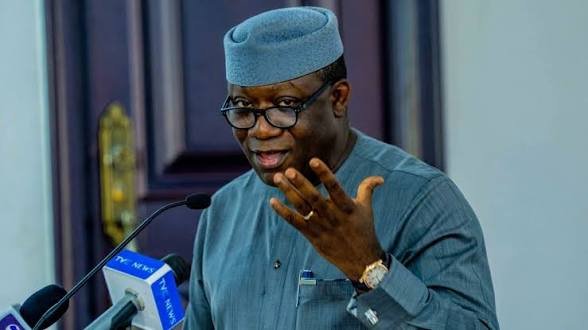
Former governor of Ekiti State, Dr. Kayode Fayemi, has urged Nigerian Catholics to be more involved in politics, warning that withdrawing from public affairs could allow individuals without strong principles to take control of government.
Fayemi made the call at the weekend, while speaking at the plenary session of Catholic Bishops Conference of Nigeria (CBCN) held at Our Lady and St. Kizito Pastoral Centre, Oke-Gada, Ede, Osun State.
The former governor, who spoke on the theme ‘Faith in Action: Empowering the Catholic Laity for Active Political Participation Ahead of the 2027 General Elections’, said Christians should not allow the perception of politics as a corrupt or “dirty” profession to keep them away from governance.
He argued that the teachings of the Catholic Church required its members to contribute to the social and political development of society.
According to Fayemi, people of faith should take their values into public service and work towards a political system that would promote justice, accountability, peace and the welfare of citizens.
“Public office is too serious to be left to people who have no fear of God. When serious Catholics committed to the ideals of social justice and the common good turn away from politics, we open the door for unprincipled opportunists to take power,” he said.
Fayemi stressed that political participation should go beyond casting ballots during elections, listed contesting for elective positions, joining political parties, monitoring elections, educating voters and demanding accountability from elected representatives as other ways citizens could contribute to the democratic process.
The former governor also cautioned Catholics against allowing ethnic considerations, religious sentiments, financial interests, political patronage or unquestioning allegiance to political parties to influence their decisions during the 2027 elections.
Instead, he advised voters to examine candidates and their proposed policies, based on issues such as human dignity, justice, security, peace, development and the common good.
Fayemi further encouraged eligible voters to register, obtain their Permanent Voter Cards (PVCs) and participate actively in voter education and election monitoring.
He said citizens should also play a role in protecting democratic institutions and ensuring that electoral processes remained credible.
The former governor called on the Catholic Church to strengthen political education among its members, particularly those interested in seeking public office.
He said encouraging Catholics to participate in politics would not be enough without giving them the knowledge and skills required to serve effectively.
Dr. Fayemi proposed structured training covering areas such as Catholic social teaching, constitutional provisions, electoral regulations, democratic governance, leadership ethics, public policy, human rights, media literacy and election monitoring.
He also urged the Catholic Youth Organisation of Nigeria (CYON) to organise programmes that would equip young people with knowledge about vote buying, voter apathy and electoral violence ahead of the 2027 elections.
Oyo, UNICEF Strengthen Auxiliary Social Workers’ Capacity For Digital Child Protection
Meanwhile, as part of efforts to strengthen child protection and social welfare services across Oyo State, the state government, in collaboration with the United Nations Children’s Emergency Fund (UNICEF), has commenced training for Auxiliary Social Workers on Child Protection Information Management System.
The state Commissioner for Women Affairs and Social Inclusion, Alhaja Faosat Joke Sanni, disclosed this during a two-day training programme for Auxiliary Social Workers, at the Conference Room of the Ministry of Women Affairs and Social Inclusion in Ibadan.
She described the training as timely and significant, noting that effective child protection required not only adequate social welfare personnel, but also accurate, timely and reliable information to support decision-making, case management, referrals, monitoring and planning.
“The state government was prioritising capacity building, community-based child protection mechanisms, alternative care, prevention of and response to violence against children, gender-based violence interventions, and the strengthening of social service delivery,” she said.
Alhaja Sanni said the knowledge and skills acquired through the training would contribute significantly to improving the quality of child protection services at the community and local government levels.
The Commissioner urged participants to take the training seriously and ensure that knowledge acquired was translated into improved service delivery in their respective areas of assignment.
The training was attended by 50 auxiliary social workers from Ibadan South-West Local Government Area (LGA) and is expected to be extended to other LGAs across the state to equip more community-based social workers with skills needed to protect children, particularly in the digital space.
Also speaking, UNICEF Child Protection Officer for Data, Planning and Monitoring, Mr. Aminu Awal-Sani, said the training formed part of efforts to support the state’s transition from paper-based to digital case management.
Mr. Awal-Sani explained that Oyo State was transitioning to PRIMERO, an electronic protection-related information management platform that would enable auxiliary social workers to identify cases, provide services and make referrals directly from the field.
He said the digital system would facilitate real-time monitoring of child protection cases and improve the availability of reliable data for decision-making and planning.
According to him, “the Child Protection Information Management Centre at the Federal Ministry of Women Affairs and Social Development in Abuja, through the National Case Management Dashboard, would be able to monitor child protection cases across all 36 states of the federation.”
In his presentation, the Child Protection Specialist, UNICEF Lagos Field Office, Mr. Dennis Onoise, stressed the need to strengthen community-based child protection structures, noting that communities had traditionally played an important role in protecting and supporting children.
Mr. Onoise said the shortage of professional social workers in the country made it necessary to build the capacity of auxiliary social workers, who could serve as a link between vulnerable children, their families, communities and formal social service institutions.
He noted that properly-trained auxiliary social workers would be better positioned to identify cases of child abuse, document them and facilitate appropriate referrals for support and intervention.
He explained that the digital information management system would enable workers to document incidents such as sexual abuse, physical abuse and harmful practices, including female genital mutilation, using mobile devices.
Onoise emphasised the importance of reliable data in addressing child protection challenges, noting that documented statistics would help governments and development partners understand the scale and nature of child protection issues and develop appropriate interventions.
Present at the training were the Permanent Secretary, Ministry of Women Affairs and Social Inclusion, Mrs. Oluyinka Shotonwa-Roagess; the Director of Child Welfare, Mr. Gbémileke Ojerinde; and the UNICEF Desk Officer in the Ministry, Mrs. Oluwawemimo Adediran, among others.
*PHOTO CAPTION: Dr. Fayemi.