








*Accuses Trio Of Repeatedly Running Fake News On His Administration
*Media Houses Deny Claim
President Donald Trump has announced that he is banning news outlets CNN, MS Now and Politico from the White House over their coverage.
In a post on his Truth Social platform on Friday (yesterday), the US President said he was expelling the media houses “effective immediately” over what he called their “constant ‘reporting’ FAKE NEWS!” and threatened that bans for other outlets could follow.
He went on: “Media Outlets shouldn’t be able to constantly write or report FICTION and LIES when they’re covering the President of the United States, the Trump Administration, or the United States of America. Other Fake News Media Outlets to follow.”
Trump defended the ban at an Oval Office event to promote his administration’s healthcare policies.
“I don’t get fair press. I get it from Breitbart. I get it from a little bit from Fox,” Trump told reporters, referring to friendly media outlets. “But what I do ask is just a semblance of truth.”
Reminded by one reporter that every President takes an oath to uphold the Constitution, including the First Amendment right to free speech, Trump said: “You get so tired of reading and seeing fake news.”
He added: “I don’t think that a court should allow fake news to be written day after day after day. I think that somebody has a right to keep them away if they’re going to write false stories all the time.”
Towards the end of a chaotic news conference, when a reporter asked Trump to explain how his ban on the three outlets would work, the President asked: “When you say ‘the ban’, which ban? Do you know how many bans I’m involved in?”
After another correspondent rephrased the question, asking, “What do you envision the bans would look like on the media outlets?”
Trump said: “Oh, the ban on the free press, right?”
On Friday, the Washington Post reported that more American service members have died in the war on Iran than the Pentagon has publicly disclosed; CNN revealed that an “entirely false” intelligence report about a Chinese ship in the Middle East generated with the help of artificial intelligence (AI) had “almost started a war”; while a Politico report uncovered a Hill investigation after sensitive F-35 fighter jet technology unexpectedly made its way to Hong Kong, possibly giving China access to them.
Trump said his decision to ban the three outlets was unrelated to these stories. “It’s really just cumulative stories over the last few years,” he said, before threatening more media prohibitions could follow.
“There may be others to join them,” Trump said.
In a statement, a spokesperson for CNN said the network “stands fully behind our White House team and their fair and accurate reporting.”
“We have a right under the US Constitution to do that reporting without hindrance or interference from the government. Should the ban which President Trump threatened go ahead, it would be an illegal assault on that fundamental and constitutionally protected right,” the spokesperson said.
Politico said its reporters would “continue to fairly report on this White House and future ones.”
“We will vigorously defend our First Amendment rights against any attempt to restrict them,” it added.
Jacqui Heinrich, President of the White House Correspondents’ Association (WHCA), said the organization “stands in defense” of the banned reporters “who are being singled out for doing their jobs.”
“This is about more than the rights of journalists,” Heinrich wrote in a statement. “It is about the right of the American people to receive a full and independent account of the activities, policies and decisions of whoever occupies the nation’s highest office.”
Since returning to office, Trump has overseen an unprecedented restriction of access for major traditional news media at the White House, including the Associated Press (AP), which was banned from press pool events in the Oval Office and on Air Force One after it continued to use Gulf of Mexico instead of Gulf of America in its coverage. The AP sued, and that case remains in litigation.
Trump’s White House also seized control over the organization of the presidential press pool, a rotation that determines which news organizations and reporters are allowed to follow – and question – the President in places such as the Oval Office and aboard Air Force One.
The WHCA, an independent association made up of members of the media, traditionally coordinated rotating pool coverage of more than a dozen journalists allowed access to the President in smaller settings.
The Pentagon also attempted to introduce a new press policy to restrict the ability of journalists to gather and report on sensitive information, which culminated in a mass walkout of news media outlets who refused to sign the pledge. A federal judge later ruled the policy was unconstitutional.
President Trump has also launched high-profile legal battles with major outlets including the New York Times, the Wall Street Journal, CNN, ABC News and the BBC.
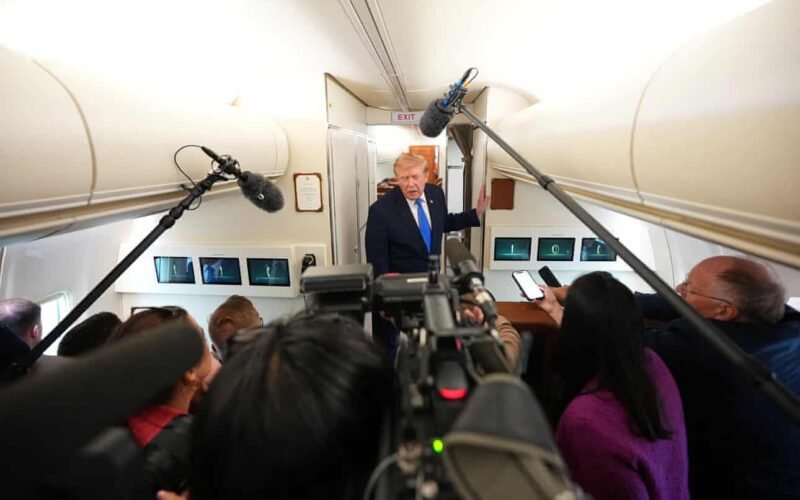
*PHOTO CAPTION: Trump addressing journalists.