











As the conflict between the United States (US), Israel and Iran continues to rage on, leaks from the Pentagon have suggested that if the US continues to strike the Islamic Republic for 10 more days, the stocks of critical missiles could run low.
On Friday afternoon, US President Donald Trump told reporters that he was not happy with the way nuclear talks with Iran had been going.
Three hours later, he gave the order to launch the operation that would take out many of the country’s top leaders, including Supreme Leader Ayatollah Ali Khamenei and over 40 top military chiefs.
Iran in retaliation targeted US bases in Bahrain, Saudi Arabia, Qatar, the United Arab Emirates (UAE) and Iraq with missiles and drones.
According to a report by Al Jazeera, Trump has been informed by the Pentagon that an extended conflict could include several risks such as facing high costs for replenishing munition stocks.
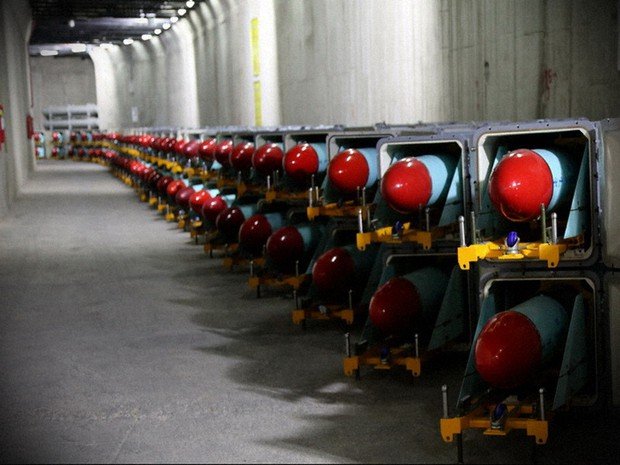
The development came as Iran publicly showcased a fortified underground tunnel housing drones and missiles, releasing footage amid escalating conflict with the US and Israel.
The Middle East nation’s Revolutionary Guard Corps (IRGC) distributed state media footage of a long underground tunnel containing Shahed-136 style drones and missile launchers positioned on vehicles.
The tunnel’s ceiling displayed the national flag and a portrait of the late Khamenei.
The video also included sequences of drones and missiles being launched, highlighting Iran’s ability to operate from fortified underground facilities.
In a matter of thinking outside the box following heavy losses it sustained in last year’s 12-day war with Israel and the US, Iran constructed underground storage networks, concealed launch facilities, and reinforced tunnels—referred to as ‘missile cities’—to preserve its ability to launch strikes after sustaining damage.
These sites are designed to protect weapons and maintain operational readiness despite enemy bombardment.
Analysts note that this infrastructure supports Iran’s use of coordinated drone and missile attacks intended to strain defences and prolong disruption at strategic locations.
However, on Tuesday, Trump wrote in a Truth Social post that the superpower’s stocks could help the US fight wars “forever”.
“The United States Munitions Stockpiles have, at the medium and upper medium grade, never been higher or better – As was stated to me today, we have a virtually unlimited supply of these weapons. Wars can be fought ‘forever,’ and very successfully, using just these supplies,” he wrote.
Although Trump had said on Monday that the strike on Iran was planned to be continued for “four to five weeks”, he said it could go on for far longer than that.
Which US Weapons Could Run Low?
Analysts told Al Jazeera that a few weapons in the US stockpile may run very low within weeks, especially interceptor missiles.
On 23 February, The Wall Street Journal reported that Pentagon officials and Chairman of the Joint Chiefs of Staff, General Dan Caine, had warned Trump about the risks of an extended conflict against Iran.
Caine had also highlighted to the Republican leader that a lack of critical munitions could hamper efforts to control a retaliation by the Iranians.
The report reveals that America’s weapons and ammunition reserves, including vital stocks for missile defence systems, are now critically depleted after military aid to allies such as Israel and Ukraine.
In last year’s war with Iran, the US had used 25 per cent of its THAAD interceptors, using 150 of them to intercept Iranian missiles. US media also reported that US ran out of ship-borne interceptors during that war.
The Al Jazeera report warns that the US risks exhausting its supplies of advanced precision munitions and key interceptors, including the THAAD system.
Among the most affected are Joint Direct Attack Munitions (JDAMs) – GPS-guided kits that convert ordinary unguided bombs into highly accurate “smart” weapons.
Experts point out that these sophisticated missile shields were built mainly to counter short, intense strikes from major powers like Russia, China or North Korea and not the kind of sustained, low-cost rocket barrages now being faced.
On Monday, US Secretary of State Marco Rubio told reporters that Iran’s production capacity far outpaces what the United States and its partners can manufacture in defensive interceptors.
“They are producing, by some estimates, over 100 of these missiles a month. Compare that to the six or seven interceptors that can be built a month,” Rubio said.
Compounding the problem, inventories of the ship-launched Standard Missile-3 (SM-3), an advanced anti-ballistic missile interceptor, are already running low because of sluggish manufacturing rates, repeated operations against Yemen’s Houthi militants and previous confrontations with Iran.
The first 24 hours of the strikes on Iran alone have seen the US spend $779 million, according to reports.
Cost Of The Iran War
Data from the Center for New American Security states that carrier strike groups (like the USS Gerald R Ford, the world’s largest aircraft carrier) cost around $6.5 million a day to operate.
In the lead-up to the strikes, which led to the elimination of Khamenei and other key figures, the US deployed two aircraft carrier strike groups, including the Gerald R Ford, in the Middle East.
Taken together, the estimated cost of the pre-strike military build-up – including repositioning aircraft, deploying naval vessels and mobilising regional assets – would be in the vicinity of $630 million.
If the war drags on, like Trump has indicated it will, the US will end up spending a staggering $210 billion, according to Kent Smetters, Director of the Penn Wharton Budget Model and one of the nation’s foremost fiscal analysts.
Since 7 October, 2023, when Hamas attacked Israel, killing nearly 1,200 people and taking 251 hostages, the US has provided $21.7 billion in military aid to Israel.
It also supported operations carried out by the country in Yemen, Iran and the wider Middle East, spending between $9.65 billion and $12.07 billion on this. Add the two figures, cited in Brown University’s 2025 Costs of War report, and you arrive at between $31.35 billion and $33.77 billion.
*PHOTO CAPTION: A section of Iran’s missile/drone fleet hid in an unknown underground location.