












In Lagos, the holiday season is well under way. For weeks, the roads have been jammed with traffic, concerts headlined by Afrobeats superstars are drawing crowds, and choice spots are filled with residents, returnees and tourists looking to indulge in the month-long enjoyment of Detty December.
But the spotlight is on the contents of kitchen pots as much as it is on those shuffling to the trendy Oblee dance steps in clubs and street parties.
This Christmas, Olawunmi George and her family of four will celebrate over plates of jollof rice and chicken at their two-bedroom apartment in Yaba, mainland Lagos.
The last time the family ate the famed West African meal was in August. Since then, they have stuck to other meals such as spaghetti, rice and stew, bread and eba, among various Nigerian staples.
The decision not to eat jollof rice was not out of choice but one necessitated by the cost of living crisis wracking the economy of Africa’s biggest country.
“You will spend a lot for the ingredients to cook jollof rice that will be to your taste,” George, who works as a cashier, says.
Jollof rice is beloved across West Africa with each country, and each family, having its own ways of preparing it.
In Nigeria, it is made with a base of tomato puree, peppers, onions, broth, margarine, curry and thyme, bayleaf and ginger, among other essentials, which is slow-cooked and stirred until the flavours coalesce before rice, often long grain, is introduced to the mix.
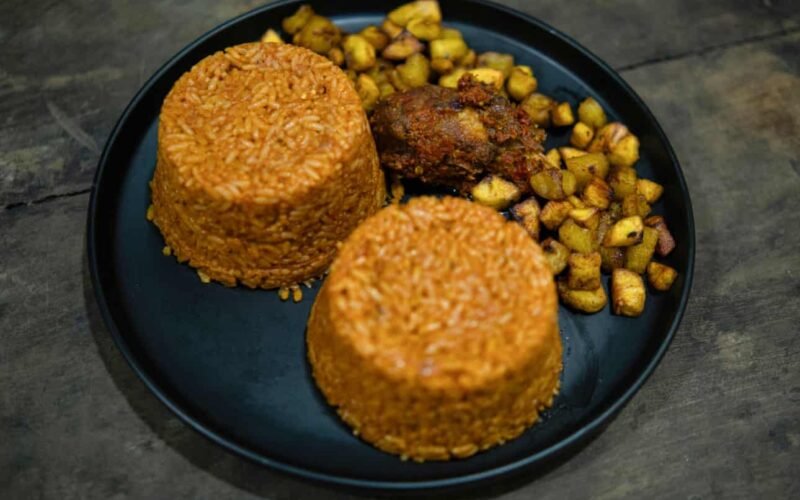
It is often served with fried plantain and a protein of choice such as turkey, chicken or beef. A true Nigerian staple at parties and family lunch, when jollof rice is served its smoky aroma draws everybody’s attention.
Today, however, the dish is appearing less on the table in Nigerian homes. The cost of preparing a pot for a family of five is N26,656 (£13.50), up from N21,300 a year ago, according to the Jollof Index, a cost of living report prepared by Lagos-based SBM Intelligence, which has tracked the effect of inflation on the dish since 2015. For context, the minimum monthly wage in Nigeria is N70,000.
Although inflation has eased for the past few months, down to 14.45% from 24.48%, this has barely had an impact on people’s buying power. For example, a bag of rice that sold for N120,000 in January now costs N65,000, but most people still cannot afford it.
Victor Ejechi, the head of insights at SBM Intelligence, says although inflation has slowed, it does not mean things are getting cheaper but that prices are rising more slowly than before.
“What the Jollof Index captures is a widening gap between prices and purchasing power. While food inflation has eased, incomes have not adjusted at the same pace. Many Nigerians are earning the same nominal wages they earned months ago, but food now takes up a much larger share of their monthly income than it used to,” Ejechi says.
Cooking jollof rice has proved too costly for Maureen Simon, a big fan of the dish.
“Imagine preparing the food for a family of six, how much do you think I will be spending? I will be spending roughly N20,000. And then there is chicken to add to it,” she says.
She now skips many of the key ingredients such as margarine, the chicken and tomato puree.
“I still try to make it taste nice with crayfish. At least, it will come out nice while making do with what I have,” the supermarket supervisor says. She uses panla, a popular cheap smoked fish, instead of chicken or beef, which contributes its own flavour.
What she ends up making is an imitation of jollof she calls “concoction rice”, lighter in colour and taste but costs much less and takes less time to prepare.
Ozoz Sokoh, a food historian, says cooking concoction rice usually begins with something the cook already has, sometimes leftover stew, and skips the luxury of slow cooking and flavour maximisation.
“Overall, the concoction is likely light in colour and a bit on flavour compared with the deeper, richer flavours and notes of jollof,” she says.
In Ghana, where jollof rice is similarly popular, the cost of making the meal is also proving a burden for families.
The Jollof Index places the cost of cooking a pot of jollof rice for a family of five at 430 cedis in a country where the daily minimum wage is 19.97 cedis.
Julianna Quist, who used to make the delicacy for her family of four three times a week, now rarely cooks it.
“I would rather cook normal rice and stew for the family than decide to cook jollof rice that is not good enough,” she says.
The price of plantain, which Quist loves to include in her version of the dish, also went up in September. In November, after saving up, she bought a large quantity of tomatoes to ensure she could prepare the delicacy this December.
The primary difference between Nigerian and Ghanaian jollof is the kind of rice used. “In Nigeria, parboiled-processed rice is common compared with non-parboiled varieties like Thai jasmine that are popular in Ghana,” says Sokoh. “There are also likely variations in method and the seasoning and spices used.”
The Nigerian version is characteristically spicier and bolder.
Ghana and Nigeria both claim to serve the best in an age-old argument which now rages on social media platforms. The latest ensuing after Nigerian chef Hilda Baci attempted to set a Guinness record for cooking the largest pot of jollof rice using 4,000kg of rice.
“Notions of superiority don’t make sense – personal preference, perhaps, but claims of one version trumping the other on a serious note are ridiculous,” Sokoh says.
Jollof has become enshrined in culture and identity. For many Nigerians, the dish is a core childhood memory. The shift to it becoming a luxury reshapes expectations, traditions, and how people define normalcy, experts say.
Ejechi notes that when households cannot cook it freely, it reflects social strain.
“The inability to prepare jollof the ‘right way’ erodes everyday cultural rituals: hosting guests, family gatherings, Sunday meals. Food becomes transactional rather than communal. Over time, this weakens shared social experiences that bind families and communities together,” he says.
*This piece & picture are taken from today’s edition of the Guardian UK.
*PHOTO CAPTION: A dish of jollof rice, fried chopped plantain and meat.