










By SHEDDY OZOENE
Barely two weeks ago, on December 7, 2025, President Emmanuel Macron of France made a statement that confirmed what many Nigerians had long feared: that his personal closeness to President Bola Tinubu may have started shaping Nigeria’s foreign policy. The fear, too, is that it may be shaped to serve French interests to the long-term detriment of Nigeria.
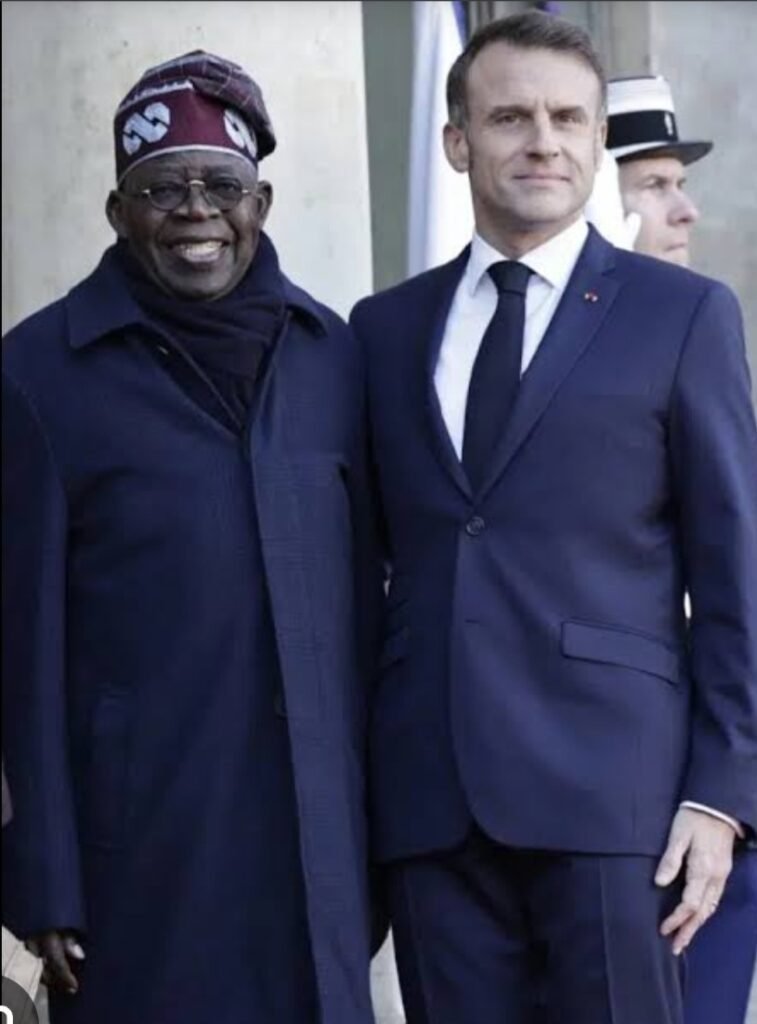
Both men have displayed a certain warmth in their relationship since Tinubu became President and literally picked Paris as his second home. On many occasions, we have seen both men in warm embrace and smile heartily into the cameras.
On that day, Nigerian fighter jets were reportedly hovering over Benin Republic to quell an uprising against President Patrice Talon, when Macron posted on his official X account that he had spoken with President Tinubu and affirmed France’s readiness to strengthen its partnership with Nigeria. His reference to Nigeria’s security threats in the North indicated that the partnership would include a military one.
Macron wrote: “I spoke with President Tinubu of Nigeria, @officialPBAT. I conveyed France’s solidarity in the face of the various security challenges, particularly the terrorist threat in the North. At his request, we will strengthen our partnership with the authorities and our support for the affected populations.”
The timing of the message, released on the day of the failed coup in Benin Republic, was too convenient to dismiss as a coincidence. For some of us puzzled by the unannounced deployment of Nigerian troops to a neighbouring country, Macron’s statement put the pieces together. It became uncomfortable to imagine that Nigeria may indeed have acted not on its own judgment, but at the prompting of the French President.
This is happening at a moment when France is being expelled from several of its former colonies in West Africa. This phenomenon is derisively called Frexit, just as the British departure from the EU was called Brexit. The idea that France may have found Nigeria as a new strategic foothold in the region is troubling enough; but the thought that President Tinubu may have sent Nigerian troops—despite our own severe internal security challenges—at the request of a foreign power is even more worrisome.
This raises a crucial question: what are the implications of President Bola Tinubu’s commitment to renewed Nigeria–France military cooperation? The answer lies in why France is being booted out of many West African countries.
Since 2022, popular anti-French sentiment has swept across the region. France’s long military presence, once justified as support for counter-terrorism efforts, has largely proved ineffective. France spectacularly failed to stem jihadist violence in Mali, Burkina Faso, Chad, and Niger. It got so bad that the mere presence of French soldiers came to be viewed as a vestige of colonial control— more like an army of occupation—rather than a genuine effort to support the fight against insurgency. Worse still, it portrayed host nations as voiceless subordinates. The belief that France’s actions were judged oppressive and deceptive, did not help matters.
Public anger escalated into massive protests, amplified by social media and nationalist movements. The juntas that emerged from coups in Mali (2020/2021), Burkina Faso (2022/2023), and Niger (2023) rode on this sentiment to assert sovereignty and revoke defence agreements with Paris.
From 2022 to 2025, Mali, Burkina Faso, and Niger Republic took turns to end military cooperation with France by ordering the withdrawal of all French troops from their territories. In November 2024, Chad—a Central African nation bordering Nigeria to the north—ended its defence pact with France, completing the withdrawal of French assets in 2025. Around the same time, Senegal and Côte d’Ivoire similarly shut down all French bases in their territories. From one corner of the Sahel to other former colonies in West and Central Africa, Macron has been scampering back home.
Despite fears that removing French forces would create dangerous security vacuums, many of these states have instead used the opportunity to reorganise their defence strategies, rally domestic support, and renegotiate foreign alliances on their own terms.
As Mali, Burkina Faso, Niger, Chad, Senegal, and Côte d’Ivoire distance themselves from Paris, France has desperately shopped for a new anchor in West Africa. In this context of massive French pullouts, Nigeria’s warm embrace of France appears out of step with regional sentiment.
Macron’s offer of military partnership may therefore be more of a Greek gift—a present that appears beneficial on the surface but is designed to entrap and possibly turn us against our neighbours. It is an offer that appears generous, especially at a time of heightened terrorist attacks, but is actually designed to lull Nigerians into a false sense of security.
The story of the Trojan Horse in Greek mythology should teach us to be wary of such gifts, especially coming from a country whose recent military interventions across West Africa have failed. Like the Trojan Horse, Macron’s gift arrives with hidden motives and strings attached.
France lost credibility in the Sahel after years of ineffective self-serving interventions, and ultimate failure. Is this the same power Nigeria now expects to help suppress Boko Haram, ISWAP, banditry, and coastal piracy? What exactly does France bring that it could not deliver elsewhere?
Accepting France’s outstretched hand may bring some diplomatic and economic benefits, no doubt, but the strategic risks are weighty. Most frightening is the potential alienation of our northern neighbours—Mali, Burkina Faso, and Niger—now united under the Alliance of Sahel States (AES) with strong pro-Russian leanings. Along with Chad, they now view France as neo-colonial and destabilising. Given their strong cultural ties with Northern Nigeria, our new alignment risks making some of our northern communities targets of hostility.
Beyond Nigeria, this development also puts a question mark on our leadership of ECOWAS, the regional bloc. How would a regional leader like Nigeria be seen in warm embrace with a colonial power facing justifiable resentment across the region?
If Nigeria becomes France’s main partner in West Africa, Paris and the EU may expect it to intervene in crises across the region—militarily or diplomatically. The episode in Benin Republic may be only the first of many acts of military outreach, just like the controversy surrounding the seizure of Nigeria’s military plane, the C-130, and eleven military personnel by authorities in Burkina Faso. It remains an allegation, but the Burkinabè authorities believe the plane was on an espionage mission in active connivance with France.
France’s new overtures may look like partnership. But like the ancient Greek gift of the Trojan Horse, not every gift is a blessing. We definitely do not need to engage in this unnecessary strategic gamble of alienating our neighbours, overstretching our military and taking on France’s discarded and discredited regional responsibilities in West Africa.