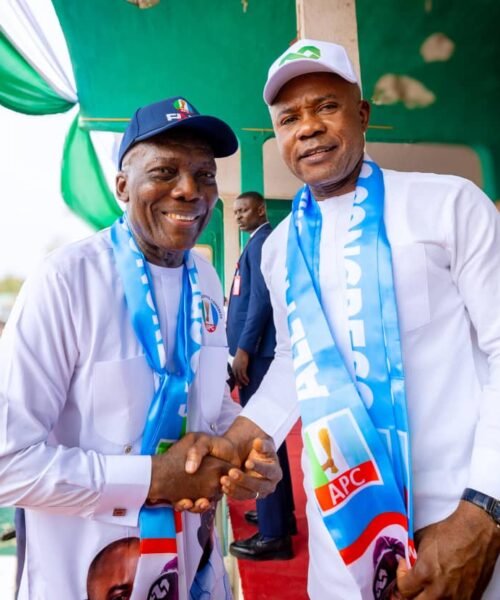







In the South-East zone, the Tinubu reelection campaign train – driven by the governors, Senators and APC elite – is surely on the move. But the coaches that should carry the people are largely empty
By SHEDDY OZOENE
In political parlance, an echo chamber emerges when party members spend more time talking to themselves than in engaging with the people. They focus on showing loyalty to their leader instead of convincing skeptical voters. In that regard, the South-East, at least for the All Progressives Congress and the all-pervasive campaign for a second term for President Bola Tinubu, is very much like one big echo chamber.
President Bola Tinubu’s second-term ambition has become the defining issue within the APC and across Nigeria’s broader political landscape. It has swept nearly all state governors into the party and crippled the major opposition parties. Yet, in the South-East, the drive has not truly taken off, not in the sense that reflects genuine public buy-in.
The people’s buy-in is paramount in every political campaign, especially in a region where the APC is still seen as existing more in symbolism than in reality. Members and their leaders appear more interested in hearing their own voices than in persuading those who remain unconvinced that the President deserves another term. Even the chants of “On Your Mandate We Shall Stand” at gatherings in Government Houses have become a hollow ritual when set against the mood of the general population in the South-East.
The recent history of the region which was a stronghold of the Peoples Democratic Party, PDP, for over 20 years until Peter Obi and the Labour Party disrupted that dominance in 2023, should be instructive. For the APC, the zone was long considered a political no-go area up until the last round of general elections. This is in spite of the fact that the party had started making inroads into the region since Hope Uzodinma became governor of Imo State in January 2020, following a Supreme Court judgment against Emeka Ihedioha of the PDP. He was quickly followed by Dave Umahi who as Ebonyi State governor, defected from the PDP to the APC ten months later in November, 2020.
It is a disruption that Obi is threatening again with his African Democratic Congress next year. Quietly and increasingly, the ADC is making progress across the country, but in the South-East, it is organising strongly by building a bottom up support base.
But from a no-go area a few years back, the fortunes of the APC have improved since after the 2023 elections. Peter Mbah who won the Enugu governorship on the platform of the PDP after a nail-biting contest against Chijioke Edeoga of the Labour Party, has since defected to the APC. The party now boasts influence with their governors in three of the five South-East states. The other two governors in Anambra and Abia—Chukwuma Soludo and Alex Otti—have shown open support for Tinubu’s second term.
For the party and for Tinubu, it has been an opportunity to consolidate. They have done little in that regard. They would rather celebrate in the belief that the high-profile decampments have translated to a seismic political shift.
On paper it is, but in reality the political sentiment of the ordinary people in the South-East has not shifted in tandem with the movements of the elite. In fact, the general belief is that those elite decampments are driven by personal interests, not by any real change in conviction.
If you talk to ordinary people across the region, you’ll find a mix of indifference and skepticism toward the APC’s growing presence. More especially, the campaign to return President Tinubu for a second term. And most of the politicians involved haven’t done much to explain their decisions, anyway. The fact is that their rhetoric, once they jump into the APC, has never been about the party or its policies, but about Tinubu.
How does everything about a political party shift from the people and policies that affect them, to the ambition of one man?
As the APC candidate in 2023, Bola Tinubu was well aware that the South-East is a region with a political mind of its own. He recognised his limited acceptability there, which explains his reluctance to campaign in the zone physically. Nearly three years in office and with the inroad he appears to have made, why is he still struggling to gain wider acceptance in the South-East?
The answer is in the justified anger in the area that his administration’s policies have had a disproportionately negative impact on the region. While some infrastructure projects are ongoing, they are seen as insufficient compared to developments in other parts of the country. The absence of clarity around key national projects such as the standard gauge rail line that doesn’t include the South-East, remains a sore point. Equally contentious is the glaring reality that federal appointments are skewed, not just in favour of a particular region, but noticeably against the South-East.
Against this backdrop, many in the region feel justified in questioning whether a continuation of the current administration would serve their interests.
Yet, instead of addressing these concerns with sincerity and respect, what the public often encounters are choreographed displays of questionable loyalty and promises of a coming Eldorado. And the Eldorado that has since manifested is the type on display by the City Boys Movement, headed by Obi Cubana, in Owerri recently. Bags of rice, grinding machines and sundry kitchen utensils. The Owerri display came at the same period the President appointed Taiwo Oyedele as the 11th Minister from the South-West – more than double that of the South-East – and just before he travelled to London to negotiate a multimillion dollar loan to renew and expand the ports in Lagos.
How should a self-respecting geopolitical zone accept to be so shabbily treated?
As 2027 draws close, the South-East is left between the rock and a hard place.
The once-dominant PDP is now a shadow of its former self in the region—its structures weakened and many of its leaders absorbed into the APC. The Labour Party, which surged in 2023, has also struggled to maintain cohesion beyond Abia State where it produced the governor. The result is a fragmented political landscape in which voters are neither fully aligned with the old order nor persuaded by the new.
As one APC leader in Enugu reportedly boasted, all they are interested in is to give President Bola Tinubu “his 25 percent” of votes cast. Perhaps that target is achievable if we remember that Muhammadu Buhari, with all the cold relationship with the region, was still able to achieve it. The question is: is that truly the extent of the President’s ambition in the South-East?
If so, it is a troubling proposition. It suggests not just a low bar for political engagement, but a deeper indifference to, and deep contempt for the region itself. A party that needs only “his 25 percent” has little incentive to genuinely compete for the trust of the people.
Which is why the party members are more engaged in the ongoing jostling for recognition, scrambling for advantage, positioning themselves as Tinubu’s foot soldiers in the impending campaign and sharing the spoils of a battle not yet fought. All these while the people and their expectations are relegated to the margins.
From the look of things, the chances of Peter Obi securing the presidential ticket of the African Democratic Congress remain uncertain. Regardless, one thing is clear about the party’s prospects in the South-East: if its leaders continue to build a truly bottom-up structure—one that listens and engages—they will find the region a low-hanging fruit. Obi’s conversation with the people remains robust, but to what end?
And that brings us to where we started. In the South-East, the Tinubu re-election campaign train—driven by governors, senators and the APC elite—is clearly in motion. The problem, however, is that the long chain of coaches meant to carry the people remains largely empty.
Does Peter Obi appeal more to the people? It would appear so, but the people will remember that the last time he showed up in 2023, they disrupted the political process by voting for his Labour Party candidates. They handed him a flock he could not hold together. So, why would they build again on quicksand?
That’s the dilemma facing the South-East.
Sheddy Ozoene, Editor-In-Chief of People&Politics, is the Vice President of the Nigerian Guild of Editors