











Iranian attacks on Dubai and the closure of its airport have triggered a scramble among the wealthy to leave the emirates via alternative routes on private jets.
The normally glitzy city – a playground for billionaires, influencers and millions of international visitors – has been on edge since drones and missiles fired in response to US and Israel strikes on Iran damaged the airport and struck several high-profile hotels and landmarks.
The United Arab Emirates (UAE) Defence Ministry said it had continued intercepting incoming missiles and drones today, as the country announced the closure of its embassy in Tehran, the Iranian capital, amid the widening regional war.
Some in Dubai have headed for Oman, a four-and-a-half-hour drive, which has seen little disruption and where Muscat airport continues to operate, albeit with delays.
The majority of commercial flights from Muscat to Europe are fully booked until later this week, according to booking sites.
Confusion mounted today over operations at Dubai and Abu Dhabi airports, with conflicting reports about departures, cancellations and when flights might resume.
Major airlines, including Emirates, flydubai and Etihad, announced they would resume a limited number of flights, mainly to help repatriate stranded passengers.
A Russian tourist, Alexandra Vavilova, holidaying in Dubai, said she had managed to secure one of the last available tickets out tonight: a flight from Muscat to Colombo, Sri Lanka.
Fares Jump Above Normal
Meanwhile, prices for private jets from Muscat have surged, driven by soaring demand and the difficulty of securing planes in the volatile region.
JetVip, a Muscat-based private jet brokerage, told the Guardian UK that a flight to Istanbul on a Nextant – one of the smallest jets available – now cost about €85,000 (about N136.2m), roughly three times the usual rate.
Seats on private charters to Moscow are going for about €20,000 (about N32m) per person.
Several private jet companies said they were currently unable to deploy aircraft because of the difficulty of positioning fleets in the Middle East.
A representative at the Austria-based AlbaJet charter firm said its “availability was extremely thin”, offering flights to Europe for about €90,000 (about N144.2m).
“Many aircraft operators won’t perform the flight due to insurance requirements and owner’s decision. So a lot of demand, very little supply,” the representative disclosed.
Fleeing By Road With SUVs Under Heavy Security
Others looking to leave the UAE have opted for the 10-hour drive to Riyadh, whose airport remains operational.
Semafor reported that private security companies had been booking fleets of SUVs to ferry clients to the Saudi capital before arranging onward private flights.
Chief Executive of the private jet brokerage Vimana Private Jets, Ameerh Naran, told the outlet that flights from Riyadh to Europe were now costing up to $350,000 (about N479.5m).
Travel Dislocations Spark Angry Backlash
The disruption has triggered a political storm in Italy after the Defence Minister, Guido Crosetto, flew home today on an Italian government aircraft, drawing criticism as hundreds of other Italians remained stranded in Dubai.
Crosetto was accused of being in Dubai on holiday with his family when the US-Israel war on Iran began.
The episode has raised broader questions in Rome about whether the government had been properly briefed on the looming conflict, prompting opposition parties to call for his resignation.
In an apparent effort to limit further backlash, he returned to Italy alone, leaving his family in Dubai. He has said he paid for the flight himself.
Reached by the Guardian UK, Crosetto said: “I am in my office dealing with far more serious matters, and I do not think that having been stranded, like thousands of other people, is an important issue.”
Other Tourists Stay Back In Dubai
For most tourists, however, the only option is to hunker down in Dubai.
Dubai’s tourist board has instructed local hotels not to evict tourists who are unable to leave the country because of mass flight cancellations, and to extend their stays on the same terms as their original bookings.
Some Russian tourists, however, complained online that they were being told to “pay up” or leave their resorts.
“The receptionist at our hotel told us to contact our booking agency, that it’s not their problem. It’s an awful attitude towards people stranded in a foreign country,” one Russian woman said in a clip circulating on Telegram.
Stranded At Sea
Thousands of Western tourists have also found themselves stranded at sea, confined to cruise ships off the Gulf coast as ports across the region grapple with the fallout from Iranian drone attacks.
At least six major cruise ships, each carrying thousands of passengers, are anchored in or close to harbours across the region, their passengers confined to the ships, and in some cases told to stay in their cabins and not go on to their balconies.
Tourists on the cruise liner Mein Schiff 4 photographed black clouds of smoke billowing over the harbour of Zayed Port in Abu Dhabi on Sunday after large explosions there caused by Iranian drones.
They told the tabloid Bild they were shocked and scared to see how their holiday paradise had turned into a war zone.
Passengers on the MSC Euribia, stranded in Dubai, said their room keys had been reissued and were now valid until 6 March, amid expectations that holidaymakers would not be able to leave the ship any time soon.
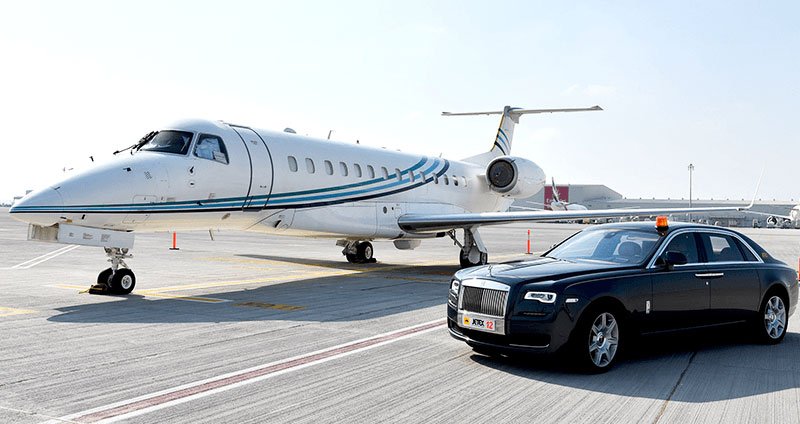
*PHOTO CAPTION: A private jet on Dubai airport tarmac.