











Fear is growing over a potential war between Iran and the US in the Middle East, with embassies evacuating staff and airlines cancelling flights as tensions mount.
High-stakes talks between the US and Iran over the future of Tehran’s nuclear programme ended on Thursday without a deal, as the White House weighs a military operation that would mark its largest intervention in the Middle East in decades.
Iranian Foreign Minister, Abbas Araghchi, claimed “good progress” had been made at the talks and Omani mediators predicted negotiations would reconvene at a technical level next week in Vienna.
But there was no immediate evidence to support suggestions that the two sides had drawn closer on the fundamental issues of Iran’s right to enrich uranium and the future of its highly enriched uranium stocks.
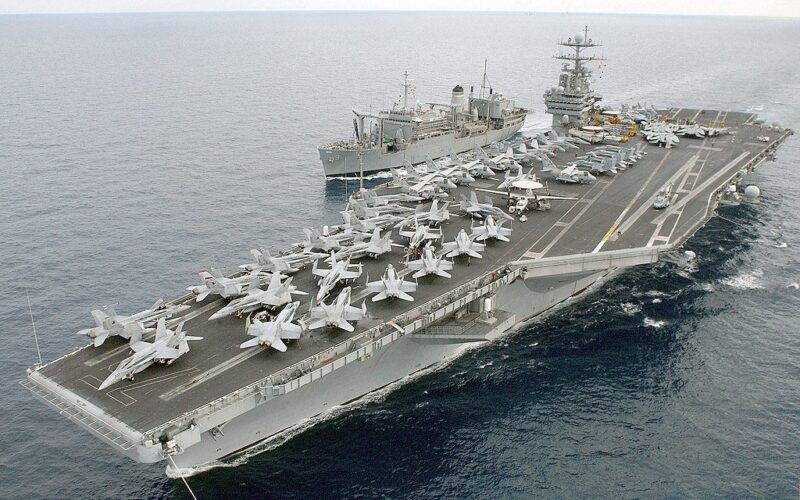
Obviously negotiating, but with a cudgel in hand, US continued her vast military buildup in the Middle East, with the Trump administration warning of drastic consequences if Iranian negotiators failed to make significant concessions.
Citizens of countries in the Middle East are bracing themselves for the possibility of regional war once again, following the numerous conflicts that have broken out since the 7 October 2023 Hamas attack on Israel and the ensuing Israeli war on Gaza.
Situation In Lebanon
In Lebanon, all eyes are on Hezbollah, as war-weary citizens fear the Iran-backed proxy group could enter any war between Washington and Tehran.
Israel has said in no uncertain terms that all of Lebanon would suffer if Hezbollah attacked, passing the Lebanese government a message that said critical infrastructure such as Beirut airport would be bombed.
People in Lebanon began taking precautions to prepare for a potential war, delaying travel so they would not be stranded outside the country, as well as stocking up on essential goods.
The memory of the 13-month war between Lebanon and Israel that killed about 4,000 people and displaced more than a million looms large in the economically beleaguered country.
Elsewhere in the region, citizens have been left to read the tea leaves themselves, trading interpretations of major news events as indications that war will or will not happen. Many have taken the decision by foreign countries to call on their citizens and diplomats to evacuate Iran and to take precautions when visiting surrounding countries as an ominous sign that escalation is imminent.
Australia Orders Diplomats’ Families Out
Australia said on Wednesday it had told dependants of diplomats in Israel and Lebanon to leave the two countries.
The Australian government has also offered voluntary departures to dependants of diplomats in the United Arab Emirates, Qatar and Jordan amid what the Foreign Ministry described as a “deteriorating security situation in the region.”
US Pulls Non-Essential Staff From Lebanon
The US pulled non-essential officials and eligible family members from its embassy in Lebanon earlier this week, citing a review of the “security environment”.
Brazil Advises Citizens To Quit Iran
Brazil recommended last week that its citizens leave Iran, after a similar alert to its citizens in Lebanon in January. Its government last year recommended that Brazilians did not travel to the two countries.
Airlines Suspend Flights
For weeks, heightened fears of a military conflict between the US and Iran have prompted airlines to suspend flights to and over countries in the region.
KLM said on Wednesday it would temporarily suspend flights between Amsterdam and Tel Aviv as of 1 March.
The Dutch arm of the airline group Air France KLM did not explicitly cite the US-Iranian tensions on Wednesday, but said in a statement it was not “commercially or operationally feasible” to operate flights to the Israeli city.
Local Implications
The Middle East has suffered intermittent military conflict on a region-wide scale since the 7 October attack, including a 12-day war between Iran and Israel, the occasional back-and-forth bombing between Houthis and the Israelis, and Israel’s bombing of Syria.
During the 12-day war in June, much of the Middle East was grounded as airlines cancelled their flights across the region.
Each night, people in Iraq, Syria, Jordan and Lebanon watched as Iranian ballistic missiles raced across their skies, occasionally exploding mid-air and landing in their backyards.
The repercussions of another war between the US and Iran, which could spill over to Israel and Iranian-backed groups across the region, extend to people’s livelihoods in the region.
Many, particularly Lebanon, Jordan and Israel, are heavily dependent on tourism – any renewed bout of conflict would further hobble their already crippled tourism sectors.
People in the region have been watching unfolding talks in Geneva with anxiety, and sharing updates and statements from Tehran and Washington across family WhatsApp chats.
The US President, Donald Trump, and his officials maintain that Iran is rebuilding its nuclear weapons programme, and must stop.
Vice-President JD Vance told reporters on Wednesday: “The principle is very simple: Iran cannot have a nuclear weapon.”
Of the negotiations, US Secretary of State, Marco Rubio, said: “I would say that the Iranian insistence on not discussing ballistic missiles is a big, big problem.”
Tehran has repeatedly pushed back against Trump’s bellicose rhetoric, accusing him of “big lies” and expressing hope that negotiations may pave the way for an agreement.
In Lebanon, the back and forth between the two powers has felt exhausting, as people wonder if their country will once again be caught up in a war.
“Can we just get it over with, whatever it is?” said one man from southern Lebanon, much of which still lies in ruins.
*PHOTO CAPTION: A US aircraft carrier ready for the war.