


*Role Of Press In Egbetokun’s Ouster
*The Sowore Angle
*The US Perspective Amid Insecurity
*Scores Of DIGs, AIGs May Go
By Felix Durumbah, Abuja
Expected to have retired since 4 September, 2024 having attained the mandatory retirement age of 60 for all public officers, Inspector General of Police (IGP) Kayode Egbetokun, has been sacked by President Bola Tinubu.
Already, the president has replaced him with Tunji Disu, an Assistant Inspector General of Police (AIG), a move which fuels speculation that the new appointee will see to the retirement of all Deputy Inspectors General (DIGs), his superiors until now, and some AIGs so as to oversee a rancour-free tenure.
Disu was appointed in acting capacity while his nomination will be confirmed by the Senate.
Egbetokun was sent home reportedly following Tinubu’s directive for him to resign yesterday, Monday, 23 February.
It was gathered that Tinubu directed Egbetokun to resign at a meeting in the Presidential Villa, Abuja, where he also thanked him for services rendered to the fatherland.
Egbetokun became the nation’s 22nd IGP on 19 June, 2023, with his substantive appointment later confirmed by the Nigeria Police Council on 31 October, 2023.
Appointed IGP when he was already 58, Egbetokun was due to mandatorily retire on 4 September, 2024, but secured tenure extension from the President, a move that drew strong opposition from some DIGs, the civil society and muck raking newspaper publisher, Omoyele Sowore, the latter who has a still raging, running battle with Egbetokun over the matter.
Sowore’s newspaper, Sahara Reporters, frequently profiled Egbetokun as “illegal IG” in its several exposes on his activities in office.
The newspaper also dug up investigative reports on the IGP’s alleged unpleasant relationship with a female cop.
Even in its edition today, the newspaper has an update on its story on the alleged involvement of Egbetokun’s son, Victor Adewale Egbetokun, in a N100million security vote scandal in Anambra State.
The apparent inability of the Force to gather adequate intelligence to curb rampaging attacks by terrorists nationwide also weighed against Egbetokun and showed total disconnect with Nigerians with the police being seen as a lame duck institution by families of victims of terror and communities frequently exposed to attacks -an issue diplomatic sources said was of “great concern” to the United States (US).
Egbetokun was seen in his last months in office as “a tired man,bereft of fresh ideas” to tackle insecurity.
IGP Egbetokun will also be remembered for bringing the image of the Force to an all-time low when his name became imprinted in the International Press Institute (IPI)’s Book of Infamy last year.
The Book of Infamy (also called the Book of Accountability for Journalists’ Rights) was unveiled on December 2, 2025, during the IPI Nigeria Annual Conference and General Meeting in Abuja.
IPI justified Egbetokun’s inclusion in the black book by pointing to what it called his alleged continued permission of a reign of a “culture of impunity” within the Force, specifically citing the harassment, intimidation, and unlawful detention of journalists, as well as a lack of corrective action.
The initiative was designed to publicly name and shame state actors who violate constitutional press freedom in the country.
It is believed that part of the reasons for his removal from office was down to his poor relationship with the press as well as scandals swirling around him -though he denied involvement in any.
Unlike Egbetokun, Disu is perceived as a friendly cop.
Among his accomplishments is his reform of the image of the Lagos Police Command’s Rapid Response Squad (RRS) which he headed between June 13, 2015, and August 2021.
While in RRS, Disu named his officers ‘The Good Guys’ –a move that helped shape them to enforce the law responsibly yet remain friendly to citizens while carrying out their activities.
The RRS under his stewardship provided services through a partnership-based and proactive problem-solving style of policing, focusing on community engagement, crime prevention and law enforcement.
His reformist actions slashed crime profile in Nigeria’s commercial capital and, in return, the RRS enjoyed the cooperation and admiration of Lagosians.
For instance, the officers reportedly routinely rendered help to drivers of broken down vehicles and assisted accident victims.
In 2020, his officers took a woman in labour to the hospital during the COVID-19 lockdown in Lagos.
Disu, born in Lagos on 13 April, 1966, was until his elevation to IGP, head of Force Criminal Investigation Department (FCID), Alagbon, Lagos.
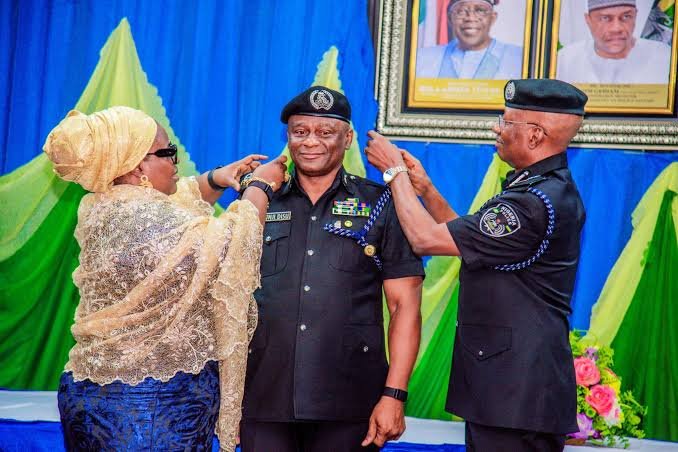
*PHOTO CAPTION: Then-IGP Egbetokun (right) helps decorate Tunji Disu (c) after the latter was promoted for a job well done.