










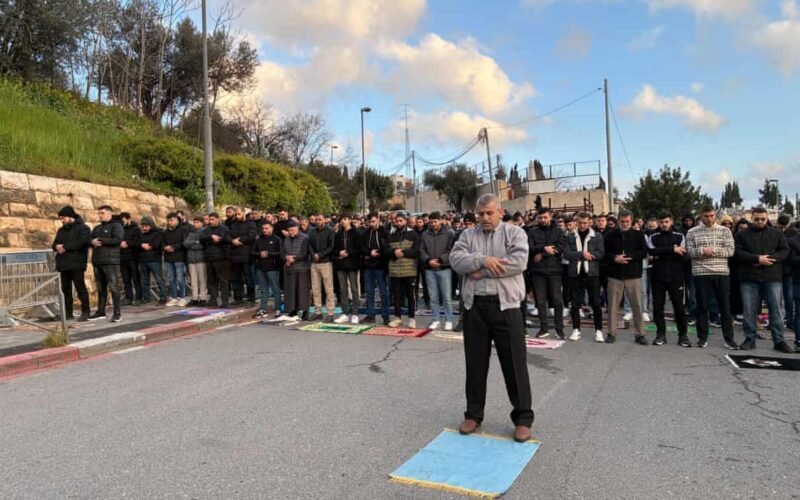
For the first time since 1967, al-Aqsa mosque – Jerusalem’s most sensitive holy site – will be closed at the end of Ramadan today, with tensions rising among Palestinians as Israeli authorities keep the complex shut, forcing worshippers to hold Eid prayers as close as they can to the sealed site.
On Friday morning, hundreds of worshippers were forced to pray outside the Old City, as Israeli police barricaded the entrances to the site.
Because of security concerns related to the US-Israeli war on Iran, on 28 February Israeli authorities had effectively sealed off the mosque complex to most Muslim worshippers during Ramadan.
Officials framed the move as a security measure linked to the escalating confrontation with Iran, leaving thousands of Palestinians to gather and pray outside the gates of the Old City instead.
However, Palestinians say the move is part of a wider Israeli strategy to leverage security tensions to tighten restrictions and entrench control over the al-Aqsa mosque complex, known as al-Haram al-Sharif to Muslims.
The mosque also encompasses the seventh-century Dome of the Rock Islamic shrine.
To Jews, it is the Temple Mount, the site of the 10th-century BC first temple (built by king Solomon) and second temple, which was destroyed by the Romans in AD70.
“Tomorrow will be the saddest day for Muslim worshippers in Jerusalem,” Hazen Bulbul, a 48-year-old Jerusalem resident who has marked the end of Ramadan at al-Aqsa mosque since childhood, told the Guardian UK.
“What I fear is that this sets a dangerous precedent. It may be the first time, but probably not the last. Israeli interference in the holy city has been escalating since 7 October [2023],” he added.
In recent months, there has been a sharp increase in arrests of Palestinian worshippers and religious staff in the Old City, alongside repeated incursions into the complex by Israeli settlers.
Police have detained individuals inside the mosque precinct, including during prayer times, and restricted access for many Palestinians seeking to enter.
The Old City, usually crowded with Palestinians in the days leading up to Eid, was largely deserted today, with streets left unusually quiet.
Palestinian shopkeepers were barred from opening most businesses, with only pharmacies and essential food shops allowed to operate. Traders said the measures had pushed them into acute economic hardship.
The preacher of al-Aqsa and former grand mufti of Jerusalem, Sheikh Ekrima Sabri, has issued a religious ruling urging Muslims to perform Eid prayers at the closest possible point to the mosque.
With a heavy security presence in the alleys of the Old City, and Israeli forces carrying out searches and confronting residents, many fear that tensions over the mosque’s closure on the final day of Ramadan could escalate into clashes with police.
Reactions Galore
The closure has drawn condemnation from the Arab League, which described it as a “blatant violation of international law” and said it risked undermining freedom of worship and inflaming tensions across the region.
The Organisation of Islamic Cooperation (OIC), the League of Arab States and the African Union Commission have expressed their strong condemnation for the closure of al-Aqsa mosque to Muslim worshippers, “especially during the blessed month of Ramadan.”
In a joint statement, they said the closure “constitutes a grave violation of the existing historical and legal status quo in the Islamic and Christian holy sites in the occupied city of Jerusalem, an assault on the established religious rights and heritage of the Islamic nation, a provocation to the feelings of Muslims throughout the world, and a violation of freedom of worship and the sanctity of holy places.”
“Israel, the occupying power,” the statement read, “bears full responsibility for the consequences of these illegal and provocative measures.”
It added that their continuation “portends an escalation of violence and tension and threatens to undermine regional and international peace and security.”
Director of the media unit in the President’s Office at al-Quds University,Khalil Assali, said the mosque’s closure was “a catastrophe for Palestinians.”
He added: “When Israelis see young Palestinians trying to pray at the closest point to al-Aqsa mosque, they run after them, they kick them out while they are praying.”
*PHOTO CAPTION: Some Palestinians praying on a street close to the mosque.