


By SHEDDY OZOENE
Kano State Governor, Abba Kabir Yusuf, appears to be learning the game of strong-arm politics rather quickly. After his controversial decision in January to abandon the Kwankwasiyya Movement and the New Nigeria Peoples Party (NNPP) that brought him to power in 2023, he now seems to be going for the jugular of his deputy, Mallam Aminu Gwarzo.
Gwarzo’s offence is simple: he refused to board the train when the governor led most members of his state executive council into the rival All Progressives Congress (APC). Since then, the buzz in Kano has been unmistakable. For having the temerity to look the governor in the eye and decline to join the decampment bandwagon, Gwarzo is now being taught a political lesson. It is a lesson designed to remind others of the cost of disloyalty to the new emperor in Kano.
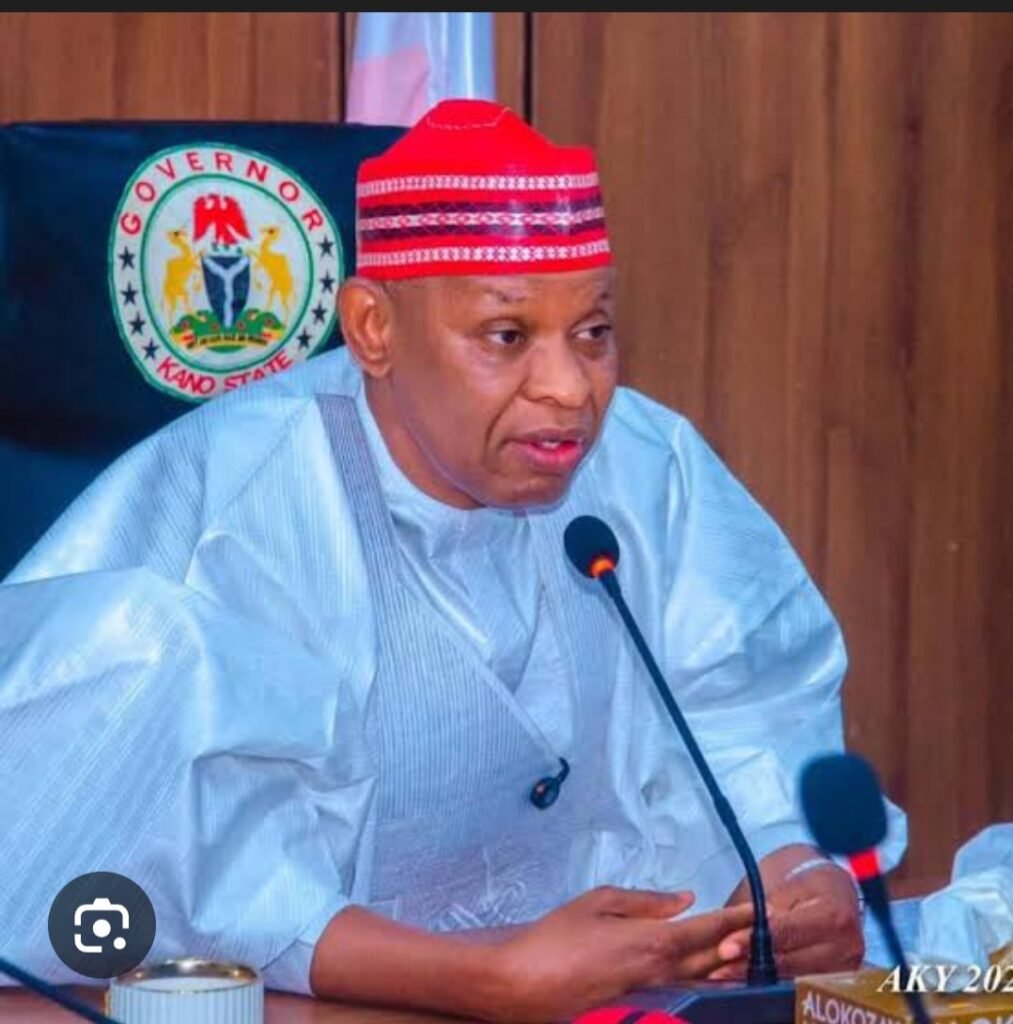
Last Thursday, the Kano State House of Assembly commenced impeachment proceedings against the deputy governor. The Assembly has since raked up a raft of allegations against him, including gross misconduct, abuse of office, breach of public trust and financial malfeasance.
I am among those who believe that the House may well be acting at the behest of Governor Abba Yusuf. Even at that, the timing of these accusations has inevitably raised more questions than answers.
Since the middle of 2025, when rumours first began circulating that the governor was contemplating a break with the Kwankwasiyya Movement that propelled him to power in 2023, it was widely understood that Gwarzo was not amused by it all. Not only did he maintain a strong relationship with Rabiu Musa Kwankwaso, the leader of the movement, he was also said to have openly expressed reservations about the governor’s new political friends
When the governor eventually took the plunge on January 23, 2026, Gwarzo was among the few members of the State Executive Council who refused to follow him. While Yusuf crossed over with dozens of former Kwankwasiyya loyalists—including members of the State House of Assembly, eight members of the National Assembly and all 44 local government chairmen—Gwarzo stood back.
In the unforgiving arithmetic of Nigerian politics, that amounted to a capital political sin.
Reading out the notice of impeachment against the deputy governor, the Majority Leader of the Assembly, Lawan Dala, alleged that while serving as Commissioner for Local Government, Gwarzo “wilfully participated in the diversion of funds allocated to local government administrations for purposes other than those for which they were appropriated.” He was also accused of receiving kickbacks of N1.5 million monthly from each of the 44 local governments between June 2023 and January 2024—amounting to N66 million per month and totalling N462 million.
The Majority Leader further alleged that between February and July 2024, Gwarzo received additional cash returns—purportedly for special assignments—amounting to N3.255 million from each local government monthly, bringing the total to N726 million. Dala also claimed that Gwarzo abused his office by facilitating payments of N10 million each from the 44 local governments to a pharmaceutical company, thereby conferring undue advantage on the firm.
The impeachment notice, signed by 38 members of the House, mandated the Speaker, Jibril Falgore, to transmit the allegations to the deputy governor. But stripped of all these procedural formality, the unfolding drama bears all the hallmarks of political retaliation. It is obvious Gov. Abba is after his pound of flesh against his deputy.
In his apparent hurry to tidy up what many in Kano still regard as an unpopular decision to defect to the APC, Governor Yusuf seems determined to leave no loose ends. Any dissenting voice—especially one within the inner sanctum of government—must be neutralised. Yet the allegations themselves raise troubling questions.
If the deputy governor indeed committed these acts while serving in the same administration, how does the governor escape political responsibility? In many ways, the accusations read less like a surgical indictment of one official and more like an inadvertent indictment of the entire government. Definitely, the future holds more revelations of those acts for which Gwarzo is facing impeachment, and which we’ve been told, has all the imprint of the governor himself.
But in the atmosphere currently prevailing in Kano politics, few may be willing—or able—to point this out. Even at this early stage, the verdict in many quarters is that Governor Yusuf—perhaps encouraged by external forces and propelled by his own political ambitions—has been taking one wrong step after another in his haste to become the new emperor of Kano politics.
Beyond the tired argument of “taking Kano to the centre,” Yusuf has offered little by way of a compelling justification for his recent defection to the APC, a move so drastic that it now threatens to define, and possibly derail, his political future.
Little wonder that many in Kano already see his move as a betrayal.
Against that backdrop, the campaign to hunt down his perceived opponents—which is how the planned removal of his deputy is widely interpreted—only deepens the perception that the governor is less interested in persuasion than in the consolidation of power. His apparent determination to silence those he suspects—rightly or wrongly—of opposing his ambition to become the undisputed leader of Kano politics has so far left a sour taste.
The issue, however, is not whether he has the numbers to impeach Aminu Gwarzo. In the arithmetic of the Kano State House of Assembly, he clearly does. The more enduring question is whether power exercised in this manner strengthens his authority, or merely weakens whatever remains of his moral standing with the people of Kano.