











*US, Israel Instigate Move To Make Tehran Fight On Many Fronts
*Offensive Expected To Open Doors For Iranian Masses To Rise, Get Rid Of Regime
*Iranian Revolutionary Guards Corps Bares Fangs At Kurds
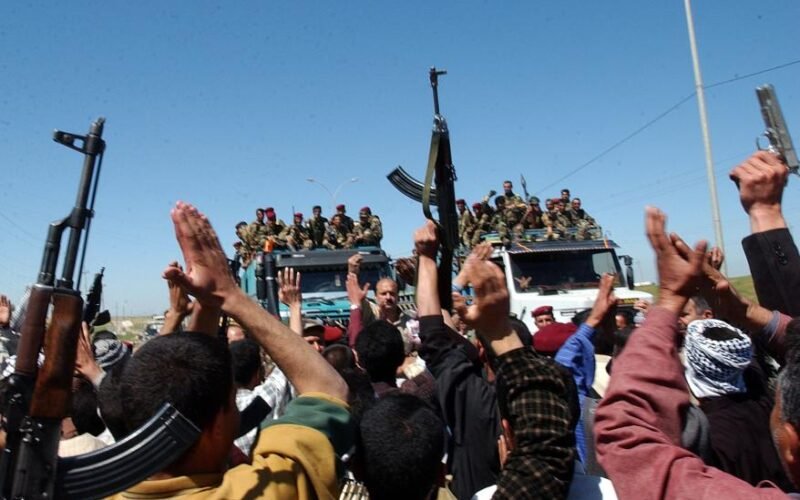
Thousands of Kurdish fighters reportedly launched a ground offensive inside Iran on Wednesday, according to reports — following claims that Israel and the US were hoping that the armed ethnic minority group could help overthrow the Islamist regime.
The Kurdish forces are operating along the Iran-Iraq border, where its major militias are based, with the goal of applying pressure to Iran’s scrambling security forces, the Jerusalem Post reported.
The ground offensive seeks to divert Iran’s military and security resources, which would open the way for an uprising inside the country, sources told the newspaper.
Apparently desirous of regime change, most Iranians are reportedly scared of double threats to their lives: the US/Israel missiles and the brutal reaction that will come from their home government which in January massacred no less than 30,000 peaceful protesters in the country.
With reports emerging of the US and Israel communicating with the Kurds, Iran’s Islamic Revolutionary Guard Corps (IRGC) has issued a warning of harsh retaliation, with a drone strike on a militia base in Iran leaving two Kurdish fighters injured on Wednesday.
It remains unclear whether the well trained Kurdish militias in the self-governed region of Iraqi Kurdistan will get involved.
Some US intel reports suggested that Iraqi Kurds were also involved in the operation, though Aziz Ahmad, a top official in the Kurdish region of Iraq denied Kurdish fighters had crossed the border into Iran.
On Wednesday, the President of the Kurdish region of Iraq, Mr. Nechirvan Barzani, talked to Iran’s Foreign Minister, Abass Araghchi, and pledged “cooperation.”
The deployment of thousands of troops comes after all six of the major political factions representing Kurds in Iran joined a new coalition on Wednesday aimed at forming an autonomous territory within the country, the groups’ leadership announced.
With more than 35 million people spread across the Middle East, the Kurds are perhaps the largest stateless ethnic group in the world.
The Kurdish people predominately live in Turkey, Iraq, Syria and Iran, with more than 8 million living in Iran, about 10% of the total population.
The Kurds, however, have long faced oppression at the hands of Tehran, which has spent decades trying to erase Kurdish culture.
“The Kurdish groups see what’s happening now as an opportunity in Iran to unite and stand for self determination,” a Kurdish studies expert at Indiana University, Hewa Khalid, told The New York Post.
“The future depends on who comes to lead Iran and how they respond to the demand of the Kurds. We could see a Kurdistan operating within Iran, or you could see the next Yugoslavia,” Khalid warned, referencing the violent division of the former Soviet state.
The Democratic Party of Iranian Kurdistan is reportedly leading the way, with the militias speaking with the Trump administration in recent days on whether, and how, to attack Iran’s security forces amid the ongoing war, officials told Reuters.
Despite decades of repression, the Kurds remain one of the most organized and well-armed opposition groups in Iran — united by their ethnic identity, with militias based in neighboring Iraq.
Kurdish fighters notably fought with the US against Saddam Hussein in Iraq, with the former dictator accused of attempting an ethnic genocide against the Kurds in the late 80s.
Kurdish militias also took on Islamist insurgents as the US tried to stabilize the country.
The Kurds also helped in the fight against the Islamic State in Syria (ISIS).
While the full size of the Kurdish militias remains unknown, major political parties have touted that they have thousands of fighters available.
Reports of their direct involvement in the Iran war comes after Israel conducted airstrikes against Iran’s military bases and police stations in Kurdish-majority cities, paving the way for an uprising, the Wall Street Journal reported.
Attacking Iran’s forces is a big gamble to the Kurds.
Failure would result in yet another brutal crackdown at the hands of Tehran, said a Middle East expert at the Center for Strategic and International Studies (CSIS), Jon Alterman.
Experts have warned that Kurdish forces alone are likely not enough to overthrow the Iranian regime.
“If the regime is still stable after this, Iran will go after the opposition, and that would be bad for the Kurds,” Alterman added. “We’ve already seen Iran’s security forces show that they are willing to fire at Iranians.”
The Kurds have been previously left to fend for themselves by the US as recently as this year when America dropped its support for the population in Syria.
Despite the previous breakdown in relations, the successful formation of a Kurdish sector in Iraq may have led the Iranian Kurds to gamble on the US one more time, said a Middle East security expert, Shukriya Mahmmoodee Bradost.
“Many don’t see what happened as a betrayal and remember how the US helped the Kurds in Iraq,” Bradost said. “Their hope is for federalism and autonomy in Iran, and they will fight for that.”
Warning the Kurds against siding with the “criminal” US and Israel, IRGC mentioned dire consequences of doing so.
“The continuation of the Americans’ deceit in the region will end at the cost of the collapse of all military and economic infrastructure in the region,” the IRGC said in a statement.
The arming of the Kurds also represents a headache for Turkish President Tayyip Erdogan, as Turkey has spent decades fighting Kurdish separatists.
A top official in the Kurdistan Region of Iraq vehemently denied that “Iraqi” Kurds were involved in the offensive.
“Not a single Iraqi Kurd has crossed the border. This is patently false,” Aziz Ahmad, the Deputy Chief of Staff to the Prime Minister of Kurdistan, wrote on X.
*PHOTO CAPTION: Kurdish fighters operating in Iraq begin a ground offensive in Iran to help topple the regime.